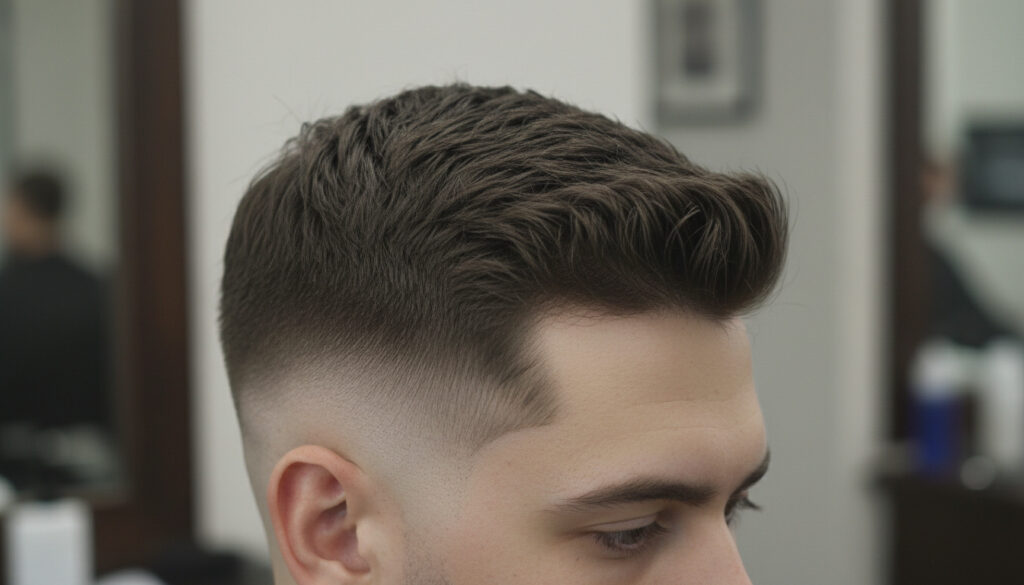
Low Taper Fade – Refined Style for Men
The Low Taper Fade: A Study in Controlled Precision
The low taper fade has cemented itself as the definitive haircut for men seeking polish without pretension. Unlike aggressive high fades that dominate the profile, this technique keeps the transition subtle, beginning just above the ear and curving naturally toward the neckline. The result frames facial features with architectural precision while maintaining enough length on top to accommodate diverse styling preferences.
Core Characteristics
Subtle Gradation
The fade initiates approximately one inch above the ear, creating a gentle slope rather than a stark contrast. This positioning preserves the natural weight line of the hair, allowing for seamless integration with professional environments while retaining stylistic edge.
Neckline Focus
Barbers concentrate tapering intensity at the nape and sideburns, eliminating bulk where the hair meets the skin. The technique requires clipper-over-comb mastery to ensure no visible lines interrupt the gradient GQ’s guide to fade techniques outlines the blade guard progression essential for this effect.
Length Retention
While the back and sides diminish to skin or stubble, the crown maintains substantial length. This dichotomy creates styling versatility impossible with uniform short cuts, accommodating pompadours, textured crops, or slicked-back arrangements.
Technical Considerations
Executing a proper low taper demands understanding of hair growth patterns and density variations. Wikipedia’s definition of tapered haircuts establishes the foundational vocabulary, but modern barbering has evolved the technique considerably.
Curlier hair types benefit particularly from this approach. The gradual transition prevents the “helmet effect” common with blunt cuts on textured hair, allowing natural curl patterns to express themselves while maintaining perimeter control. Barbers working with coarse or wiry textures must adjust their clipper angles to prevent irritation at the fade’s lowest points.
| Variant | Starting Point | Best For | Maintenance |
|---|---|---|---|
| Low Taper | Above ear | Oval/round faces | Every 2-3 weeks |
| Mid Fade | Temple level | Longer face shapes | Every 2 weeks |
| High Fade | Recession line | Dramatic contrast | Weekly touch-ups |
| Skin Taper | Sideburns to skin | Clean professional look | Every 10 days |
Anatomical Nuances
The distinction between a taper and a fade often generates confusion among clients. A taper strictly refers to gradual length reduction, typically ending in short hair rather than exposed skin. The low taper fade hybridizes these approaches, pushing the temple area to near-skin levels while maintaining faint hair presence at the hairline.
This matters significantly for men experiencing temporal recession. The technique camouflages thinning areas by reducing surrounding density, creating optical density where hair remains. Men’s Health styling strategies confirm that strategic fading ranks among the most effective non-invasive approaches to managing hair loss visibility.
Historical Trajectory
The fade’s origins trace to military grooming standards of the 1940s and 1950s, where hygiene requirements mandated short perimeter hair. However, the specific “low” placement emerged from African American barbershops in the 1980s, where precise clipper work became cultural currency.
By the 1990s, the style migrated into mainstream fashion through hip-hop culture and professional sports. The 2000s saw refinement through celebrity barber innovations, introducing texture-specific techniques. Today’s iterations incorporate razor detailing and color enhancement, though the fundamental geometry remains unchanged.
Distinguishing Features
Clients often request “just a fade” without understanding the gradient implications. The low positioning specifically suits individuals with prominent ears or those seeking to soften jawline angularity. Unlike mid fade variations that create horizontal emphasis across the temples, the low taper directs visual attention upward toward the eyes and cheekbones.
The neckline treatment further distinguishes quality execution. A tapered neckline follows the natural hairline without creating hard geometric shapes, growing out more gracefully than blocked or rounded alternatives. This proves essential for clients unable to visit barbershops weekly.
Professional Perspectives
Master barbers emphasize the consultation phase as critical for this particular cut. Hair density at the parietal ridge—the point where the sides meet the top—determines whether the fade should incorporate a “drop” lower in back or maintain consistent elevation around the head.
“The low taper is forgiving but unforgiving simultaneously,” notes industry veterans. “Growth patterns hide imperfections less effectively than with longer styles, yet the technique accommodates irregularities better than high fades where discrepancies sit at eye level.”
Client Experiences
“I switched from a standard business cut three years ago. The low taper gives me the flexibility to look conservative Monday through Friday, then add texture and volume for weekends without visiting the barber twice.”
— Marcus Chen, Sydney
“As someone with coarse, curly hair, finding a style that looked professional without constant maintenance seemed impossible. The taper keeps my neckline clean for three weeks, and the length on top actually behaves better than when I tried to grow it out uniformly.”
— James O’Brien, Melbourne
Maintenance Architecture
The style demands rhythm. While the cut itself provides grace periods between appointments, the aesthetic relies on sharp perimeter definition. Most wearers schedule visits every fourteen to twenty-one days, depending on hair growth velocity and contrast preference.
Between appointments, hair type considerations dictate product selection. Fine hair requires matte clay to prevent separation at the fade line, while thick or curly textures benefit from light pomade to maintain moisture at the exposed lower scalp areas.
Common Questions
Does a low taper fade suit thin hair?
Yes, particularly for thinning concentrated at the crown or temples. The technique reduces weight at the perimeter, creating the illusion of density where hair remains longer. However, individuals with diffuse thinning across the entire scalp may find the contrast emphasizes sparse areas rather than concealing them.
How should I communicate this style to my barber?
Request a “low taper with natural neckline,” specifying the desired length on top separately from the fade parameters. Bring reference photographs showing the specific gradient density you prefer—terms like “low fade” vary significantly between barbershops.
Can this style accommodate facial hair?
The transition from fade to beard requires particular attention. A skilled barber will blend the lowest fade point into sideburns, then continue the gradient into beard density. This creates cohesive framing rather than isolated hair islands. BeardBrand’s integration techniques demonstrate optimal fade-to-beard mechanics.
What is the difference between a taper and a low fade?
Pure tapers maintain short but visible hair at the neckline, typically using scissors over comb. A low fade introduces clipper work taking the hair to skin level at the lowest points, creating higher contrast. Most modern “low tapers” actually represent hybrid approaches.
More related posts
 L-Shaped Desk Ireland: Best Picks with Storage for Home Office
 James Marsden: Separating Fact from Fiction in His Life
 Arjun Rampal: Biography, Age, Net Worth, and Controversies
 Parenting Payment in Ireland: Eligibility, Amounts & Benefits
 Igo Share Price – Live Data, Charts and Forecast
 Jeff Bezos: Net Worth, Age, Height, Ethnicity, and More
 Ray-Ban Sunglasses Buyers Guide: Price & Authenticity