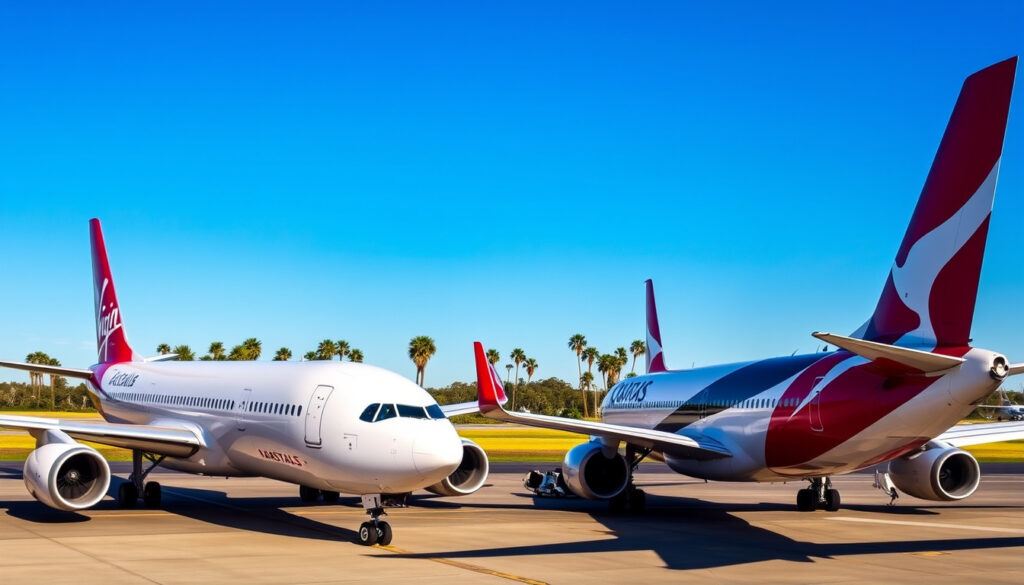
Virgin Airlines Australia: Qantas Comparison and Reviews 2025
Australia’s airline duopoly forces travellers to make a real trade-off: Qantas delivers premium cabin experience and stronger safety perception, while Virgin Australia consistently beats it on cancellation discipline and value-for-money trust. A consumer survey found 48% of respondents trust Virgin Australia most for affordability versus 25% for Qantas — but 63% associate Qantas with the word “safe.” This guide puts the 2025 data front and centre so you can pick the airline that actually fits your priorities.
Headquarters: Brisbane, Queensland · Domestic Destinations: 50 within Australia · Total Destinations: Approximately 70 · Status: Australia’s second largest airline · Former Name: Virgin Blue
Quick snapshot
- Virgin Australia is Australia’s second-largest airline, operating ~50 domestic routes and serving approximately 70 destinations total Virgin Australia Newsroom
- Separate brand from Virgin Atlantic — no shared flight network DemosAU Brand Analysis
- Virgin Australia achieved NPS +26 versus Qantas NPS +25 in 2025 traveller survey of 1,056 respondents DemosAU Brand Analysis
- Exact current ownership structure post-2020 voluntary administration
- Details of future international expansion plans beyond existing New Zealand, Bali, and Pacific routes
- Whether the Qatar Airways partnership will extend to additional routes in 2026
- Virgin led on-time and completion for first half of 2025 (82.1% average on-time, 98.1% completion) Australian Aviation
- Qantas overtook Virgin in June 2025 and maintained lead for five consecutive months through October Australian Aviation
- Virgin Australia regained on-time departure leadership in October 2025 (82.7%) Virgin Australia Newsroom
- Both carriers benefiting from strong 2025 demand, per ACCC competition review ACCC Report
- Velocity loyalty program expanding partnerships; Qantas Frequent Flyer adding more international partners (ACCC Report)
- On-time performance race likely to intensify as carrier capacity recovers (ACCC Report)
| Attribute | Value |
|---|---|
| Founded as | Virgin Blue |
| Base | Brisbane |
| Total Destinations | 70 total |
| Velocity Loyalty Partners | Some flights operated by partner airlines |
| Virgin Australia NPS (2025) | +26 |
| Qantas NPS (2025) | +25 |
| Value for Money Trust (Virgin) | 48% |
| Safety Association (Qantas) | 63% |
| Avg On-Time First Half 2025 | 82.1% |
| Oct 2025 Cancellation Rate | 1.4% |
Is Virgin Australia a good airline to fly with?
Whether Virgin Australia is “good” depends heavily on what you prioritised before boarding. For value-focused travellers, the carrier holds clear advantages. In a 2025 DemosAU survey of over 1,056 travellers, Virgin Australia achieved a Net Promoter Score of +26, edging out Qantas at +25. Passengers consistently praised Virgin staff friendliness and the airline’s lower cancellation record.
Passenger reviews
The DemosAU brand analysis revealed meaningful demographic splits in how Australians perceive the two carriers. Virgin Australia resonated strongly with travellers seeking value for money — 48% of respondents identified Virgin as the airline they most trust for affordability, compared to just 25% for Qantas. However, Qantas scored significantly higher on safety perception: 63% associated Qantas most strongly with the word “safe.” One in five Virgin Australia passengers chose the carrier for its lower fares rather than brand loyalty, while one in five Qantas choosers admitted they flew out of habit.
Recent rankings
Australian Aviation’s analysis of BITRE data shows Virgin Australia held the highest average on-time performance among major Australian carriers for the first six months of 2025, at 82.1%, with a completion rate of 98.1%. The carrier’s official newsroom reported that for January 2026, Virgin achieved an 82.7% on-time departure rate and 99.1% completion rate — the highest among major Australian airlines for that month. Critics note that Qantas scores higher in formal satisfaction surveys but faces criticism for longer customer service wait times.
Which is better Qantas or Virgin Australia?
The honest answer is that Qantas and Virgin Australia serve meaningfully different traveller priorities, which is why the rivalry has stayed competitive for over two decades. Neither carrier is objectively better — but each has a clear profile.
Service and fares
Qantas typically positions itself as the premium option, with meals, drinks, and entertainment included on most routes. Virgin Australia keeps fares lower but charges for extras that Qantas bundles in. According to Airspace Times, Qantas pricing ranges from AUD 200–2500 while Virgin Australia operates in the AUD 100–800 range for comparable domestic routes. Qantas also maintains higher baggage allowances and personal seat-back screens on international flights.
Routes and reliability
The on-time picture flipped several times in 2025. For the first half of the year, Virgin led. Then Qantas overtook Virgin in June 2025 and maintained the on-time performance lead for five consecutive months through October, according to Australian Aviation. In June 2025, Qantas achieved 75.2% on-time arrivals versus Virgin’s 72.1%; Qantas cancellations sat at 2.6% versus Virgin’s 1.4%. By October 2025, Virgin Australia had reclaimed the on-time departure lead.
Qantas wins on punctuality and premium cabin quality, especially on long-haul international routes. Virgin Australia wins on cancellation discipline and base fares. For frequent domestic flyers who hate disruptions more than delays, Virgin’s lower cancellation rate may matter more than Qantas’s better on-time arrival percentages.
Is Virgin Australia the same as Virgin airlines?
No. Virgin Australia is a distinct Australian domestic and short-haul international carrier. It shares the Virgin brand with Virgin Atlantic, but the two operate entirely separate networks — Virgin Atlantic does not fly to Australia, and Virgin Australia does not serve Atlantic routes. This brand sharing can confuse travellers searching for “Virgin airlines” when they mean Virgin Atlantic.
Differences from Virgin Atlantic
Virgin Australia focuses on trans-Tasman, Pacific, and Southeast Asian routes, with primary hubs in Brisbane, Sydney, and Melbourne. Virgin Atlantic, headquartered in the UK, serves long-haul Atlantic routes between the UK, US, Caribbean, and Africa. The Qatar Airways partnership gives Virgin Australia limited access to Middle Eastern hubs, while Virgin Atlantic operates its own independently extensive global network. Booking a flight to London via Virgin typically means Virgin Atlantic, not Virgin Australia.
Searchers typing “Virgin Atlantic Australia” into a browser often land on Virgin Australia’s site only to find no London flights. Both carriers maintain their own loyalty programs — Velocity Frequent Flyer for Virgin Australia, Virgin Atlantic’s Flying Club — with no direct point transfer between them.
Is Virgin Australia a low budget airline?
Virgin Australia occupies an uncomfortable middle ground: not a budget carrier by New Zealand’s Jetstar standards, but not a full-service airline by Qantas’s definition. The carrier’s positioning has shifted since its founding as Virgin Blue — a clear low-cost operator — into something more layered.
Pricing model
Virgin Australia offers what the industry calls “value fares” rather than stripped-down budget pricing. The airline’s app rating improved dramatically from 2.8 to 4.7 in recent years, signalling a significant operational upgrade that sits somewhere between budget and full-service. Fares are consistently lower than Qantas equivalents on comparable routes, but the gap reflects service differences rather than bare-bones operations.
Service level
Virgin Australia provides complimentary refreshments on most domestic flights, standard seat selection, and decent legroom on Boeing 737s. The carrier does not match Qantas’s international baggage allowances or personal entertainment screens on long-haul flights. The ACCC’s October 2025 domestic airline competition review noted that both Qantas Group and Virgin Australia benefited from strong demand in the first half of 2025, suggesting both carriers have room for premium and value tiers in their customer bases.
Does Virgin still fly in Australia?
Absolutely. Virgin Australia remains Australia’s second-largest airline, actively operating across 50 domestic destinations and approximately 70 total routes including New Zealand, Bali, and Pacific Island destinations. The carrier survived voluntary administration in 2020 and has rebuilt its network steadily since, posting its highest completion rates on record in 2025.
Current routes
Virgin Australia’s domestic network covers every major Australian city and many regional routes, with Virgin Australia Regional Airlines handling thinner routes. In October 2025, Virgin Australia Regional Airlines recorded just 1.2% cancellations — the lowest among comparable regional operators. The carrier’s international footprint includes New Zealand, Fiji, Samoa, Bali, and select Pacific points, supported by the Qatar Airways codeshare for connecting passengers beyond the Middle East.
Booking and check-in
Virgin Australia’s digital tools improved substantially with the app overhaul that lifted its rating to 4.7. Manage booking, online check-in, and flight status tracking are available through the app and website. Phone support exists but shows notable gaps: only 7% of Virgin Australia customers said their issue was fully resolved through phone support, per Alternative Airlines’ comparison. Mobile check-in and self-service rebooking via app are considerably more reliable paths for most changes.
The data paints a clear operational split: Virgin leads on completion and cancellation discipline, while Qantas has held the on-time arrival edge for most of 2025.
| Metric | Virgin Australia | Qantas | Source |
|---|---|---|---|
| NPS Score (2025) | +26 | +25 | DemosAU |
| Value for Money Trust | 48% | 25% | DemosAU |
| Safety Association | — | 63% | DemosAU |
| On-Time Arrivals June 2025 | 78.0% | 80.4% | Australian Aviation |
| On-Time Arrivals Oct 2025 | 72.1% | 75.2% | Australian Aviation |
| Cancellation Rate Oct 2025 | 1.4% | 2.6% | Australian Aviation |
| Avg On-Time First Half 2025 | 82.1% | — | Australian Aviation |
| Business Travel Preference | 26% | 43% | DemosAU |
| Holiday Booking Preference | 28% | 38% | DemosAU |
| Domestic Fare Range (AUD) | 100–800 | 200–2500 | Airspace Times |
| Velocity / Frequent Flyer Preference | 38% | 49% | DemosAU |
| Higher Income ($200k+) Preference | 19% | 49% | DemosAU |
Five data points, one consistent story: Qantas leads on perception metrics (safety, premium, business), Virgin Australia leads on operational efficiency (cancellation discipline, value, completion rates). Neither carrier dominates across the board — the comparison table is essentially a trade-off map.
The implication for budget-conscious travellers is clear: Virgin Australia delivers better operational reliability on the metrics that matter most when things go wrong.
| Attribute | Details |
|---|---|
| Fleet | Boeing 737NG, Boeing 737 MAX, Embraer E190 |
| Primary Hub | Brisbane Airport (BNE) |
| Loyalty Program | Velocity Frequent Flyer |
| Alliance Partners | Qatar Airways, Etihad, Singapore Airlines, Hawaiian Airlines, Air New Zealand |
| Cabin Classes | Economy, Business (domestic), The Business (international) |
| App Rating (current) | 4.7 stars (significant improvement from 2.8) |
| On-Time Departure Jan 2026 | 82.7% |
| Completion Rate Jan 2026 | 99.1% |
| Lowest Cancellation Rate 2025 | 1.4% (October 2025, mainline) |
| Customer Support | App-based self-service highly rated; phone support satisfaction low (7% full resolution) |
| Domestic Route Count | Approximately 50 destinations |
| International Route Count | Approximately 20 destinations |
Upsides
- Lowest cancellation rate of major Australian carriers in 2025
- Strong value-for-money perception (48% trust for affordability)
- Best-in-class app experience improvement
- Velocity program competitive for domestic spending
- Friendlier staff reputation in passenger feedback
- Higher completion rates mean fewer stranded passengers
Downsides
- Trails Qantas on on-time arrivals for 5 consecutive months to June 2025
- Lower safety perception (63% associate Qantas, not Virgin, with “safe”)
- Phone support resolution rate critically low (7%)
- Premium international product limited versus Qantas
- Higher-income travellers prefer Qantas by 2.5:1 margin
- Fewer business-route frequencies than Qantas on some corridors
Virgin Australia has maintained the lowest average cancellation rate of the major Australian airlines for 2025 so far.
— Danny Norman, Virgin Australia GM, Integrated Operations Centre
For the first six months of the year, our average on-time performance rate of 82.1 per cent and average completion rate of 98.1 per cent were the highest of the major Australian airlines.
— Chris Snook, Virgin Australia COO
The January results reflect the dedication and teamwork of Virgin Australia’s people across every part of the operation.
— Dave Emerson, Virgin Australia CEO
Summary
Virgin Australia holds a distinct position in Australia’s airline market: operationally disciplined, value-oriented, and recovering steadily from its 2020 restructuring. The 2025 data shows a carrier that delivers where Qantas stumbles — fewer cancellations, better completion rates, stronger value perception — while trailing on punctuality streaks and premium reputation. The ACCC’s May 2025 competition review confirms both carriers are benefiting from strong demand, suggesting the rivalry is sustainable rather than zero-sum. For Australian travellers, the real question is not which airline is objectively better, but which one is better for your specific trip profile.
For the frequent business traveller who can expense time lost to delays, Qantas’s five-month on-time lead may justify the premium fare. For the leisure traveller who hates being bumped or rebooked, Virgin Australia’s cancellation discipline and lower base fares offer meaningfully better odds. Higher-income Australians already know their preference — 49% choose Qantas versus 19% for Virgin among those earning over $200,000. The rest of the country, it turns out, splits more evenly than the brand battleground suggests, which means most travellers have genuine reason to evaluate Virgin Australia on its own operational merits rather than defaulting to the better-known brand.
Related reading: Queensland public holidays · Best phone plans Australia
Virgin Australia’s status ownership and recovery underscores its recovery as Australia’s second-largest carrier, edging Qantas in value trust per 2025 data.
Frequently asked questions
Who owns Virgin Australia?
Virgin Australia emerged from voluntary administration in 2020 with a restructured shareholder base. While exact current ownership details are not fully transparent in public filings, the carrier operates independently from Virgin Atlantic following the restructuring. Several investment entities hold significant stakes, but no single majority owner controls the airline as of 2025.
How do I manage a booking with Virgin Australia?
Use the Virgin Australia app or the “Manage Booking” section on the official website. You can change seats, add baggage, modify flight times, and handle most rebooking tasks digitally. Phone support is available but has a low full-resolution rate (7%), so digital self-service is the recommended path for most changes.
How do I check in for Virgin Australia flights?
Online check-in opens 24 hours before departure via the Virgin Australia app or website. Airport kiosk check-in and counter check-in are also available. The mobile app is generally the most reliable option and allows you to generate a digital boarding pass to add to your phone wallet.
Does Virgin Australia offer international flights?
Yes, Virgin Australia serves international routes including New Zealand, Fiji, Samoa, Bali, and select Pacific destinations. A Qatar Airways codeshare extends reach to Middle East and European connection points. However, Virgin Australia does not operate long-haul flights independently like Qantas does on routes to London, Los Angeles, or Johannesburg.
What are Virgin Australia contact options?
Virgin Australia customer contact options include phone support, email inquiry forms, social media channels (Twitter/X and Facebook), and the app’s in-app messaging feature. Phone support resolution rates are notably low — only 7% of customers report full issue resolution through phone. Digital channels via the app and website are considerably more effective for most transactions.
What awards has Virgin Australia received?
Virgin Australia has earned multiple industry recognitions including Airline of the Year titles at Australian travel awards ceremonies. The carrier’s official newsroom documents awards related to service quality and operational performance. Beyond awards, the 2025 NPS score of +26 and the DemosAU traveller survey results represent meaningful consumer recognition independent of formal award programs.
How does Virgin Australia compare to budget airlines?
Virgin Australia sits above budget carriers like Jetstar in service tier while remaining more affordable than Qantas. Unlike Jetstar, Virgin includes complimentary refreshments on most domestic flights and provides more flexible fare options. Virgin is not a stripped-down budget product — it’s a value-oriented full-service carrier with an improved app experience and operational reliability comparable to or better than Qantas on cancellation metrics.
More related posts
 Tommy Hilfiger: Brand Analysis, History & Perception
 Mazzy Star: The Tragic Story and What Happened to the Band
 Shah Iran: Biography, Overthrow, and 1979 Revolution
 James Dean Death: Last Words, Cause, Car Crash & Legacy
 Tere Ishq Mein 2025: Cast, Trailer, Netflix & Songs
 Sarah Silverman: Relationships, SNL Firing, and Career Facts
 Red Roses: Complete Symbolism, Care & Buying Guide
 10 Play Activation: How to Activate on Any Smart TV