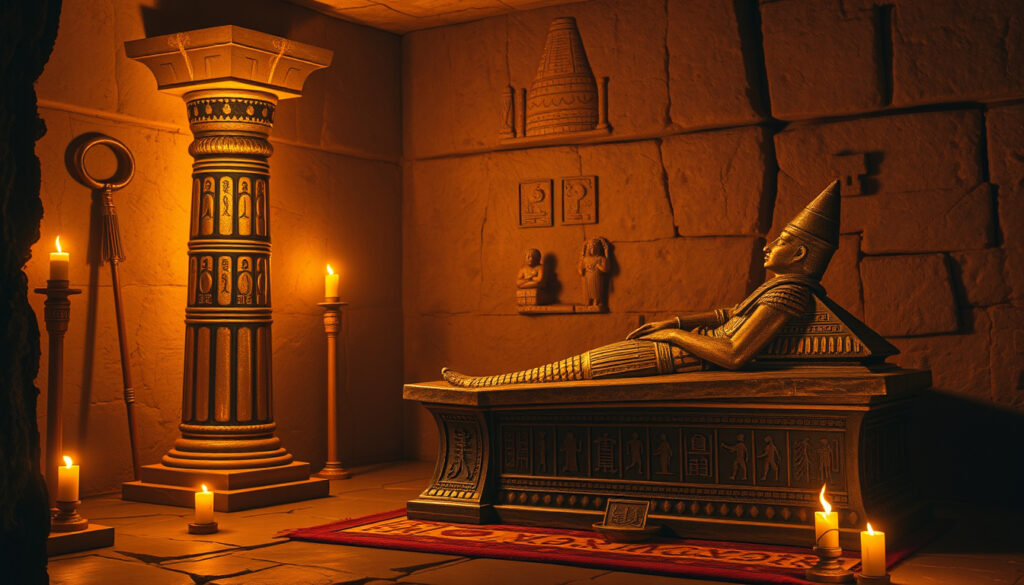
Osiris God: Myth, Family, Symbols & Role in Egyptian Afterlife
Few figures from the ancient world manage to be both a god of the fertile, life-giving Nile flood and the stern judge of the dead — that’s the paradox at the heart of Osiris, the Egyptian deity who was murdered by his own brother, resurrected by his wife, and went on to become one of the most enduring symbols of rebirth in human history. This guide unpacks his family drama, his powers, and how he came to rule the underworld — with sources you can check yourself.
Pantheon: Ancient Egyptian ·
Role: God of the afterlife, death, resurrection, fertility, agriculture ·
Consort: Isis ·
Parents: Geb (earth) and Nut (sky) ·
Siblings: Isis, Set, Nephthys ·
Symbol: Djed pillar, crook and flail, Atef crown
Quick snapshot
- Osiris was the brother-husband of Isis (World History Encyclopedia)
- He was murdered by his brother Set, then restored by Isis (World History Encyclopedia) (World History Encyclopedia)
- Abydos became his major cult center (Penn Museum Expedition)
- Exact etymology of his name — scholars still debate its meaning (Encyclopaedia Britannica)
- Whether Osiris was originally a historical king before becoming a god (Encyclopaedia Britannica) (Encyclopaedia Britannica)
- Earliest references around c. 2400 BCE in the Pyramid Texts (World History Encyclopedia) (Brown University Archaeology)
- His cult grew through the Middle Kingdom and into the Roman era (Brown University Archaeology)
- New archaeological work at Abydos continues to refine the picture of his cult (Brown University Archaeology)
Five key facts about Osiris, one pattern: his identity is built on opposites — a god who dies yet brings life, who rules the dead yet guarantees rebirth.
| Label | Value |
|---|---|
| Name in hieroglyphs | Wsjr |
| Centers of worship | Abydos, Busiris |
| Major festival | Osiris Mysteries at Abydos |
| Depicted as | Mummified king, green or black skin |
| Part of triad | Osiris, Isis, Horus |
Who Was Osiris’ Wife?
The short answer is Isis — his sister, his queen, and the goddess who put him back together after Set tore him apart. In Egyptian theology, she wasn’t just a spouse; she was the active force that made his resurrection possible (World History Encyclopedia). Their pairing is so central that almost every funerary scene with Osiris also includes Isis (Egyptian Museum).
Isis: Goddess of Motherhood and Magic
- Isis was a powerful goddess in her own right — the archetypal mother and the mistress of magic (Encyclopaedia Britannica)
- She is the one who reassembled Osiris’ body and conceived Horus through magical means (World History Encyclopedia)
The Divine Marriage of Osiris and Isis
The marriage of Osiris and Isis is not a love story in the modern romantic sense; it’s a cosmic arrangement. Their union represents the cycle of death and rebirth that ensures the Nile floods and crops grow again. Without Isis, Osiris stays dead; without Osiris, there’s no renewal. The pattern here is mutual dependence — neither god functions alone (World History Encyclopedia).
The implication: Osiris’ mythology doesn’t work as a solo act. His power is activated through Isis — she’s the engine that turns his death into a promise of life.
Did Osiris Marry His Sister?
Yes — Osiris married his sister Isis (World History Encyclopedia). That sounds shocking to modern ears, but it was normal for Egyptian royalty and gods. Incest among the divine family wasn’t a scandal; it was a way of preserving the purity of the royal bloodline, mirroring what human pharaohs did in practice.
Royal Sibling Marriages in Ancient Egypt
- Pharaohs often married sisters to keep the throne within the divine family line
- The gods’ sibling marriages were a mythological reflection of this royal custom
Mythological Parallels in Other Cultures
Ancient mythologies across the Mediterranean pair siblings in divine marriages — the Greek Zeus married his sister Hera, for example. For the Egyptians, this wasn’t taboo; it was structural. The union of Osiris and Isis echoed the original creation when Geb (earth) and Nut (sky) produced their children (World History Encyclopedia).
What this means: calling Osiris and Isis “siblings” misses the point. In the Egyptian worldview, their marriage was the template for royal legitimacy — not a breach of it.
Is Osiris Good or Bad?
Osiris is unambiguously a good figure in Egyptian mythology — a benevolent ruler, a fair judge, and a god of renewal, not a punisher. He’s often described as the judge of the dead, weighing the hearts of the deceased against truth (Encyclopaedia Britannica). The “evil” role in his story belongs to Set, his brother, who kills him out of jealousy.
Osiris as a Benevolent Ruler and Judge
- As judge, Osiris presides over the weighing of the heart in the Hall of Two Truths
- He offers the possibility of rebirth, not eternal punishment, to the deceased (Encyclopaedia Britannica)
Osiris as the God of the Dead – Not Evil
Being god of the dead in Egypt didn’t mean ruling a dark underworld. It meant overseeing the cycle of death and rebirth, which was seen as a continuation of life, not an end. The green or black skin in his depictions signals fertility and regeneration, not decay (World History Encyclopedia).
Osiris is often imagined as a dark, foreboding lord of the dead, but his actual mythology is about hope: the promise that, like him, the deceased could be reborn. His “dark” realm was a place of renewal, not torment.
The trade-off: Osiris’ goodness is conditional — it only applies to those whose hearts are light enough to pass judgment. But unlike punitive deities, his court offers a path to rebirth, not damnation.
How Did Osiris Get Isis Pregnant?
Isis conceived Horus after Osiris was already dead and dismembered. According to the myth, Set murdered Osiris, cut his body into pieces, and scattered them across Egypt. Isis, with her magic, found and reassembled the pieces — or in some versions, fashioned a replacement — and revived Osiris just long enough to conceive their son Horus (World History Encyclopedia).
The Resurrection of Osiris by Isis
- Set killed Osiris and scattered his body parts; Isis gathered them (World History Encyclopedia)
- Isis used her magical powers to restore Osiris to life temporarily
Conception of Horus
Horus was conceived posthumously — a detail that makes him a symbol of divine intervention and legacy. His birth was literally a product of magic, not biology. This is why Horus becomes the avenger of his father, ultimately defeating Set and restoring order to Egypt (World History Encyclopedia).
Why this matters: the conception of Horus is the linchpin of the whole myth. It turns Osiris’ death from a tragedy into a victory — his legacy lives on through his son, solidifying his role as a god of succession and kingship.
Are Anubis and Osiris the Same God?
No — Anubis and Osiris are distinct deities with different responsibilities in the afterlife. Anubis, the jackal-headed god, is the embalmer and guide who prepares the dead for judgment. Osiris, the mummified king, is the ruler of the underworld who presides over that judgment. They’re partners in a process, not the same entity.
Separate Roles in the Afterlife
- Anubis: god of embalming and mummification, guides souls to the afterlife
- Osiris: lord of the underworld, judges the dead (World History Encyclopedia)
Anubis: Embalmer and Guide
Anubis is the older deity in Egyptian mythology, predating Osiris as the primary god of the dead. His role as embalmer is tied to the myth where he helped Isis mummify Osiris’ body, making him the patron of the mummification process.
Osiris: Lord of the Underworld
Osiris took over as the supreme god of the underworld, while Anubis remained the gatekeeper and guide. This shift reflects the evolution of Egyptian religious thought, as Osiris’ resurrection story became central to funerary beliefs.
| Aspect | Anubis | Osiris |
|---|---|---|
| Primary role | Embalmer and guide | Lord and judge of the underworld |
| Domain | Mummification, funeral rites, threshold of the afterlife | Afterlife judgment, resurrection, kingship |
| Mythological origin | Older deity, predates Osiris cult | Rose to prominence during Old Kingdom |
Confusing Anubis and Osiris muddles the entire Egyptian afterlife process. Anubis gets you through the door; Osiris is the judge behind the bench. They’re complementary, not interchangeable.
The pattern: Anubis is the practical guide — the one who gets you to the judgment hall. Osiris is the ultimate authority — the one who decides your fate. You need both.
Osiris’ Role and Significance in Egyptian Culture
Osiris wasn’t just a myth; he was a cultural force that shaped how Egyptians lived, died, and buried their dead. His cult at Abydos became one of the most important pilgrimage sites in Egypt, with annual processions reenacting his funeral (Penn Museum Expedition). The belief that Osiris was buried at Abydos made the site a prime destination for those who wanted to be near their god in death (Brown University Archaeology).
His symbols — the crook and flail, the atef crown, the djed pillar — were not just decoration. They were statements about his dual nature as both king and resurrected god (Encyclopaedia Britannica). The djed pillar, often associated with Osiris, is one of the most important symbols of stability and endurance in Egyptian culture (Wikipedia entry for Osiris).
Let’s look at how Osiris evolved over time:
- c. 2400 BCE: Earliest known references to Osiris in the Pyramid Texts
- Old Kingdom: Osiris becomes associated with the afterlife and the dead king
- Middle Kingdom: Osiris Mysteries become popular at Abydos, attracting pilgrims
- Ptolemaic Period: Cult of Osiris spreads throughout the Mediterranean
- Roman Era: Osiris worship continues, syncretized with Serapis
The implication: Osiris wasn’t a static figure. His cult grew and adapted over millennia, absorbing local traditions like Khentiamentiu at Abydos and eventually merging with Greek and Roman deities (Penn Museum Expedition). This adaptability is why he remained relevant for over 3,000 years.
“The cult of Osiris conditioned both royal and private activity at Abydos.”
— Brown University Archaeology, on the site’s enduring significance
“You are Osiris, the son of Geb and Nut, the one who was killed and restored to life.”
— World History Encyclopedia, summarizing the Pyramid Texts (c. 2400 BCE)
For the Egyptian people, the choice was never between life and death — it was between life, death, and rebirth. Osiris’ story made that rebirth possible, and his cult gave every Egyptian, not just pharaohs, a share in that promise (Brown University Archaeology).
en.wikipedia.org, pt.wikipedia.org, youtube.com, en.wikipedia.org, mythopedia.com, simple.wikipedia.org
Frequently asked questions
What is the Osiris myth?
The Osiris myth tells of the god-king Osiris, who ruled Egypt well, was murdered by his jealous brother Set, and was resurrected by his wife Isis to conceive their son Horus. The myth explains the cycle of death and rebirth and establishes Osiris as lord of the underworld (World History Encyclopedia).
How did Osiris die?
Osiris was killed by his brother Set, who tricked him into a chest, sealed it, and threw it into the Nile. Set then dismembered Osiris’ body and scattered the pieces across Egypt (World History Encyclopedia).
What is the djed symbol in Egyptian mythology?
The djed pillar is a symbol of stability and endurance, most strongly associated with Osiris. It’s thought to represent his backbone and his role as a durable, resurrecting god (Wikipedia entry for Osiris).
Was Osiris a real person?
There’s no historical evidence that Osiris was a real king. He’s a mythological figure, though some scholars suggest his myth may draw on real royal succession conflicts. His origins as a deity are unclear, with the earliest references in the Pyramid Texts around 2400 BCE (Encyclopaedia Britannica).
Who killed Osiris?
Set, Osiris’ brother, killed him. Motivated by jealousy, Set murdered Osiris, dismembered his body, and scattered the pieces — a crime that Horus, Osiris’ son, would later avenge (World History Encyclopedia).
What does Osiris judge in the afterlife?
Osiris judges the hearts of the dead against the feather of truth (Ma’at) in the Hall of Two Truths. Those who pass are reborn; those who fail are destroyed by the devourer Ammit (Encyclopaedia Britannica).
Is Osiris the same as Serapis?
Not exactly. Serapis was a syncretic deity created during the Ptolemaic era, combining aspects of Osiris and the Greek god Apis with Zeus and Hades. He was a blend, not a copy — created for political and religious unity (Encyclopaedia Britannica).
Where was Osiris buried?
The cult center at Abydos held the belief that Osiris was buried there, specifically at a site called Umm el-Qaab. Annual processions reenacted his funeral at Abydos, making it the most sacred burial site in Egypt (Penn Museum Expedition).
Related reading
- King Edward VII — a historical monarch guide
- John Lackland — a king, a charter, and a crisis
More related posts
 Dyson Air Straight – Review, Price and Verdict
 Luke Bryan Wife, Health Scare, Family Tragedy – Full Bio
 PanOxyl Acne Wash Review: Does It Work & Where to Buy
 Matt Passmore: What Happened to the Actor? Career & Personal Life
 Who Is Aisling Bea’s Baby Daddy? Her Children & Partner
 ACT Public Holidays 2026: Full Official Dates List
 Warren Tredrea: AFL Career, Legal Battle and Board Fallout