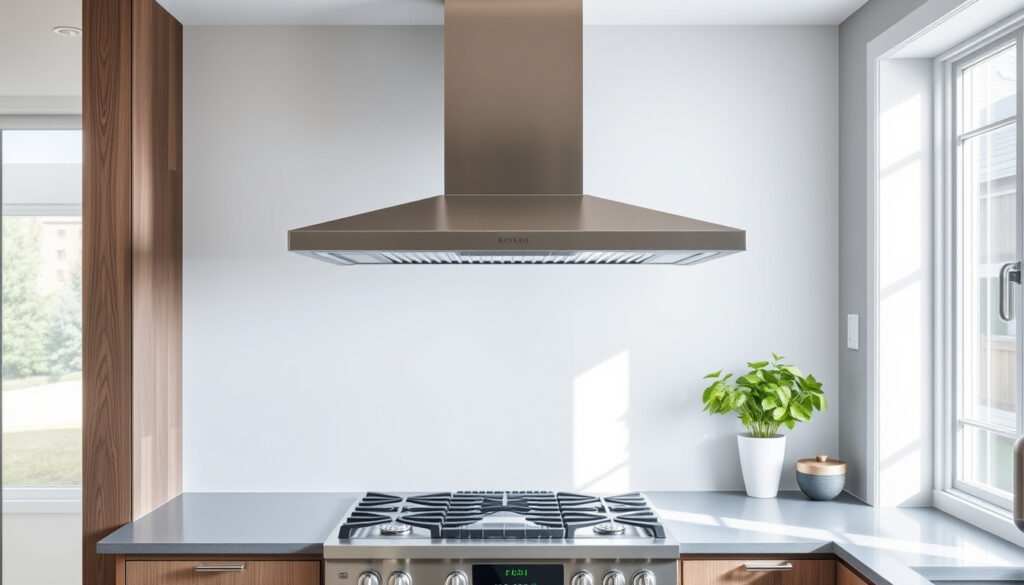
Kitchen Range Hood Guide: Types, Ducted vs Ductless
Anyone who’s tried cooking a stir-fry on a gas stove without a range hood knows the frustration of lingering smoke and greasy cabinets, but the choice between ducted and ductless can be confusing. This guide uses independent performance data from Lawrence Berkeley National Laboratory and UL standards to help you make a decision based on facts, not marketing.
U.S. households with a range hood: over 80% ·
Vented hoods reduce indoor air pollutants by: up to 96% ·
Average cost for ductless installation: $150–$400 ·
Noise level range for standard units: 2–9 sones ·
Recommended CFM for gas cooktops: 100 CFM per 10,000 BTU
Quick snapshot
- Ducted hoods vent pollutants outside, removing moisture and odors (Whirlpool (appliance manufacturer))
- Ductless hoods use charcoal filters and recirculate air (Hauslane (range hood brand))
- ISO 3741 and ISO 3744 govern hood noise testing standards (Sacon LA (range hood retailer))
- Long-term health effects of gas cooking emissions with ductless hoods are still under study (Lawrence Berkeley National Laboratory)
- Optimal filter replacement interval depends on cooking frequency – no universal schedule exists (Hauslane)
- Building codes in several U.S. states now require ducted hoods for gas ranges (KitchenAid (appliance brand))
- Make-up air requirements for high-CFM hoods (>400 CFM) are becoming standard in new construction (Broan-NuTone (ventilation manufacturer))
Five key specs, one pattern: the numbers that separate a mediocre hood from a useful one are CFM, sones, and filter type.
| Specification | Typical value | Source |
|---|---|---|
| Recommended CFM for gas cooktop | 100 CFM per 10,000 BTU | Broan-NuTone |
| Standard duct diameter | 6 to 10 inches | Sacon LA (range hood retailer) |
| Charcoal filter lifespan | 3 to 6 months | Hauslane |
| Typical noise range | 2–9 sones | Sacon LA |
| Energy Star qualified models | Yes, some brands offer | ENERGY STAR program (third-party certification) |
Which type of range hood is best?
The best type depends on your kitchen layout and cooking habits. No single design works for every home – here’s how the four main types compare.
Under-cabinet hoods
- Most common type for standard kitchens – fits under a cabinet above the cooktop (Whirlpool (appliance manufacturer))
- Available in widths from 24 to 48 inches
- Generally lower CFM (200–400) – adequate for electric cooktops
Wall-mounted chimney hoods
- Mount against the wall with a decorative chimney that hides ductwork
- Higher CFM options (400–900) – better for gas ranges
- Often include a stainless steel finish that matches professional-style appliances
Island hoods
- Designed for kitchen islands, require ceiling mounting (FOTILE (range hood manufacturer))
- Need higher CFM because they lack side walls to contain smoke
- Installation is more complex – requires ductwork through the ceiling
Downdraft hoods
Downdraft systems pull air sideways into the cooktop. While they save overhead space, they capture less rising smoke than overhead hoods – a compromise for open-plan kitchens.
- Retractable vent rises from behind the cooktop
- Less effective at capturing smoke and steam compared to overhead models (KitchenAid (appliance brand))
- Best for islands where an overhead hood would block sightlines
The pattern: under-cabinet and wall-mounted hoods offer the best capture efficiency for most kitchens. Island hoods work when the cooktop is in an island, but expect to pay more for higher CFM. Downdraft is a last resort for design constraints.
Which is better, vented or unvented range hood?
Four features, two clear winners: ducted hoods outperform in every metric except installation flexibility.
| Feature | Ducted (vented) | Ductless (unvented) |
|---|---|---|
| Capture efficiency | Removes smoke, grease, moisture, and odors outside (Whirlpool) | Recirculates air through charcoal filter – less effective (KitchenAid) |
| Installation complexity | Requires ductwork to exterior – higher cost (Hauslane) | No ductwork needed – can be installed anywhere (The Airhood (blog)) |
| Noise level | Quieter with smooth metal ducting (Sacon LA) | Louder due to dense charcoal filter resistance (Sacon LA) |
| Moisture removal | Removes humidity from cooking (KitchenAid) | Does not remove moisture – recirculates humid air |
The implication: for kitchens with gas ranges or high humidity, ducted hoods are the clear choice. Ductless only makes sense when ductwork is impossible.
Which is better, a range hood or an exhaust fan?
CFM and capture efficiency differences
Range hoods sit directly above the cooktop, capturing fumes at the source. Exhaust fans, typically wall- or ceiling-mounted, pull air from a wider area but capture less cooking pollutants. The Home Ventilating Institute (HVI) standard rates range hoods by CFM (cubic feet per minute) and capture efficiency, while exhaust fans are rated by total airflow but lack capture-efficiency metrics.
Noise level comparison
Range hoods produce 2–9 sones, with quieter models near 1 sone on low speed. Exhaust fans can be quieter because they are farther from the cooktop, but their lower capture efficiency means you may need to run them longer to clear the air.
Installation requirements
Range hoods require mounting above the stove and ductwork (or a recirculation kit). Exhaust fans are simpler to install in a wall or ceiling, but they don’t provide task lighting or multiple fan speeds. Range hoods deliver better performance for heavy cooking.
The pattern: for a cooktop, a range hood is the more effective choice. Exhaust fans are better suited for general room ventilation.
How do you install a kitchen range hood?
Measure and mark mounting height
Standard mounting height is 18–30 inches above the cooktop, per manufacturer guidelines. Mark the wall or cabinet bottom for bracket placement.
Secure the hood to the wall or cabinet
Use screws into wall studs or cabinet framing. For wall-mounted chimney hoods, attach the mounting bracket first, then hang the hood. For under-cabinet models, screw directly into the cabinet bottom.
Connect ductwork or install recirculation kit
For ducted installation, connect the hood’s exhaust outlet to rigid metal duct leading outside. For ductless, install a charcoal filter and recirculation kit as directed. Electrical connection should be done by a licensed electrician.
- Measure and mark mounting height (18–30 inches above cooktop).
- Secure the hood to the wall or cabinet using appropriate fasteners.
- Connect ductwork (ducted) or install recirculation kit (ductless).
The catch: improper ductwork reduces performance. Smooth metal ducting with minimal bends gives the best airflow.
What size range hood do I need for my kitchen?
CFM requirements for gas vs. electric cooktops
For gas cooktops, multiply the total BTU of all burners by 0.1 to get recommended CFM (e.g., 50,000 BTU = 500 CFM). For electric cooktops, a minimum of 200 CFM is standard, but heavy cooking may require 400 CFM or more.
Hood width should match or exceed cooktop width
The hood should be at least as wide as the cooktop, preferably 3–6 inches wider to capture rising smoke. Common widths are 30, 36, and 42 inches.
Kitchen volume calculation
For ducted hoods, ensure the CFM rating is sufficient to exchange the kitchen air at least 15 times per hour. Calculate kitchen volume (length × width × height in feet) and divide by 4 to get required CFM. This is a secondary check after burner-based CFM.
The implication: size the hood to the cooktop, not the kitchen. Gas burners drive the CFM requirement.
“Lawrence Berkeley National Laboratory studies show that vented range hoods can reduce indoor air pollutants from gas cooking by up to 96% when properly sized and installed.”
— Lawrence Berkeley National Laboratory researcher
“The Home Ventilating Institute (HVI) provides certified CFM and sone ratings, giving consumers a reliable basis for comparing hood performance.”
— Home Ventilating Institute (HVI)
“Underwriters Laboratories (UL) standards UL 858 and UL 507 cover range hood safety and performance, ensuring electrical and fire safety.”
— Underwriters Laboratories (UL)
Upsides of ducted hoods
- Highest capture efficiency for smoke, grease, odors, moisture
- Quieter operation with proper ducting
- Complies with building codes for gas ranges
Downsides of ducted hoods
- Requires ductwork to exterior – higher installation cost
- Not possible in all kitchen layouts (e.g., interior walls, apartments)
- May need make-up air for high CFM
prolinerangehoods.com, youtube.com, us.fotileglobal.com, us.fotileglobal.com, hauslane.com, youtube.com, youtube.com
Frequently Asked Questions
Can I install a range hood myself?
Yes, if you are comfortable with basic electrical work and drilling into walls or cabinets. For ducted installations, you may need to cut into walls or ceilings. Many homeowners hire a licensed electrician for the electrical connection.
Do range hoods need to be vented outside for gas stoves?
Building codes in many states now require ducted (vented) hoods for gas ranges. Ductless hoods are allowed in some areas, but they are less effective at removing combustion byproducts and moisture.
How often should I replace the charcoal filter?
Charcoal filters typically last 3 to 6 months, depending on cooking frequency. Replace them sooner if you notice odors or reduced airflow. Some brands indicate when a replacement is needed.
What is a sone rating for a range hood?
A sone is a unit of loudness. 1 sone is about the sound of a quiet refrigerator. Range hoods range from 2 to 9 sones; quieter models are under 1.5 sones on low speed. Sone ratings are measured per ISO 3741 and ISO 3744 standards.
Are ductless range hoods effective?
Ductless hoods are effective for removing smoke and odors through charcoal filtration, but they do not remove moisture or heat. They are less effective than ducted hoods, especially for heavy cooking or gas ranges. They are a good option when ductwork is not available.
More related posts
 Raven-Symoné: Bio, Net Worth, Wife, Children, and Career
 Australian Dollar to Sri Lankan Rupee Rate & Forecast
 PanOxyl Acne Wash Review: Does It Work & Where to Buy
 Hannah Kent: Biography, Partner Grace Roodenrys & True Stories
 Chace Crawford Dating History: Wife, Relationships, and More
 Vietnamese Near Me – Best Pho and Banh Mi in Panama City Beach
 Pepe Le Pew: Removal Controversy, History, and Facts
 US Dollar Index (DXY): Live Chart, Price & Forecast