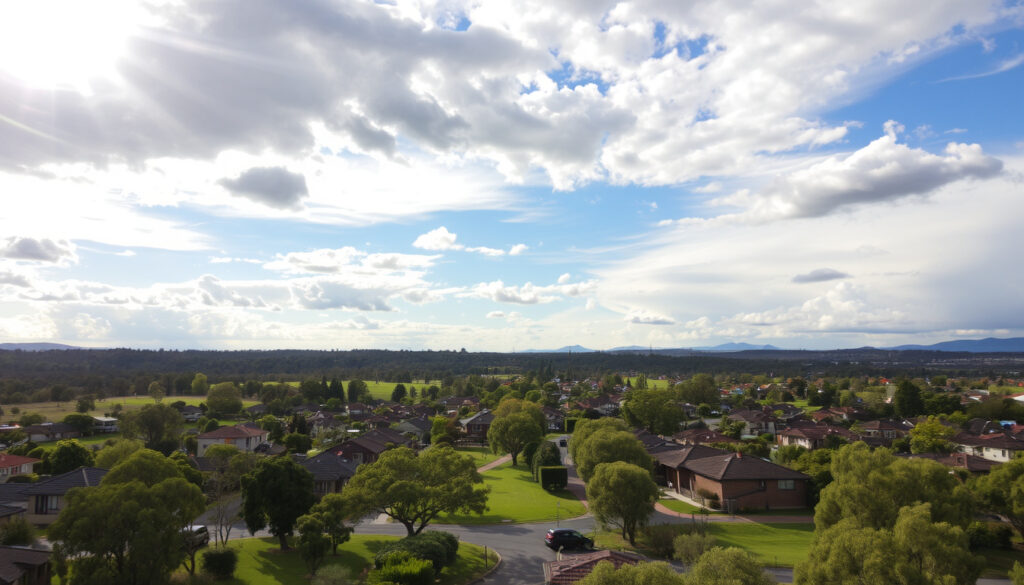
Rouse Hill Weather – Current Conditions and 7-Day Forecast
Rouse Hill, located in Sydney’s north-west corridor in New South Wales, experiences a temperate climate shaped by its inland position relative to the coast. Temperatures recorded across available forecast data range from overnight lows near 10°C to afternoon highs that can reach 33°C during warmer periods, according to data sourced from the Bureau of Meteorology and third-party monitoring stations.
April sits within Sydney’s autumn season, typically bringing cooling temperatures, easing humidity, and a gradual increase in rainfall probability compared with the summer months. Conditions across Rouse Hill at this time of year tend to shift between clear sunny mornings and afternoon cloud build-up, with occasional shower activity.
Because live weather data changes minute to minute, the figures outlined here reflect observed ranges and forecast patterns reported by multiple meteorological sources. For the most precise real-time reading, official providers should be consulted directly.
What Is the Weather in Rouse Hill Today?
10–13°C reported across recent monitoring data
Mostly cloudy to clear; variable throughout the day
High up to 19–33°C / Low 10–16°C depending on the day
Winds 15–30 km/h; light surface readings near 5–6 km/h
Several key patterns emerge from the available meteorological data recorded for the Rouse Hill area:
- Temperatures at the lower end of the reported range (10–13°C) reflect early morning and overnight readings from AQI monitoring stations covering the Quakers Hill and Rouse Hill corridor.
- Daytime highs have been observed as high as 33°C during warmer forecast windows, while typical autumn afternoons are more likely to peak in the low-to-mid 20s.
- Humidity sits between 62% and 94%, with higher readings typically occurring overnight and in the early morning hours.
- Wind speeds at the surface level are light at around 5–6 km/h, though upper-level gusts of 15–30 km/h have been recorded in some forecast periods.
- Rain probability ranges widely — from 0% on dry, clear days to 70% during active shower or thunderstorm periods.
- The UV Index can reach very high levels (9–10) on sunny days, requiring sun protection from approximately 8:40 am to 4:40 pm.
| Metric | Reported Range / Value | Source |
|---|---|---|
| Current Temperature | 10–13°C (observed low-end readings) | AQI.in, Weatherzone |
| Daytime High | 19–33°C across forecast periods | Bureau of Meteorology |
| Overnight Low | 10–16°C | Bureau of Meteorology |
| Humidity | 62–94% | AQI.in |
| Surface Wind | 5–6 km/h (light) | AQI.in |
| Upper Wind Gusts | 15–30 km/h, occasional 36–38 mph gusts | BOM, AccuWeather |
| UV Index | Low (cloudy) to Very High (9–10, sunny) | Bureau of Meteorology |
| Rain Probability | 0–70% depending on the day | BOM, AQI.in |
| Precipitation Amount | Trace to 11.5mm per event | AQI.in, BOM |
| Sun Protection Window | ~8:40 am – 4:40 pm on high UV days | Bureau of Meteorology |
Rouse Hill 7-Day Weather Forecast: What to Expect Through the Week
The available forecast data from the Bureau of Meteorology’s Rouse Hill forecast page shows a typical autumn pattern for Sydney’s north-west — a mix of sunny intervals, increasing cloud cover mid-week, and periodic shower activity. Exact day-by-day figures shift with model updates and should be treated as indicative ranges rather than fixed values.
Temperature Trends Over the Coming Days
Daytime highs across a 7-day outlook are generally expected to remain in the 19–25°C range under typical autumn conditions for this area, with warmer anomalous days potentially reaching higher. Overnight lows have been recorded as low as 10°C, consistent with April’s cooling pattern in the Greater Sydney basin.
Temperature variance between day and night is notable in Rouse Hill’s inland location. The area sits further from the coast’s moderating sea-breeze influence compared with suburbs closer to the Sydney CBD or Northern Beaches, meaning it tends to record both warmer daytime peaks and cooler overnight minimums.
April in Sydney’s north-west typically marks a transition period. The Bureau of Meteorology records a gradual cooling trend as summer heat dissipates, with daytime highs easing toward the low 20s and overnight temperatures dropping into the low-to-mid teens. Rain chances become more evenly distributed compared to the summer storm-season pattern.
Hourly Forecast Patterns
Hourly data from AccuWeather’s Rouse Hill hourly forecast shows temperatures gradually rising from early-morning lows through to a mid-afternoon peak, before cooling again after sunset. Cloud cover tends to build during the morning hours on days with forecast shower activity.
Wind behaviour follows a similar diurnal pattern — generally calm in the early hours, picking up to 15–30 km/h during the afternoon, then easing overnight. Gusts above this range have been observed on days with active frontal or storm systems.
Even in autumn, the UV Index in Rouse Hill can reach very high levels (9–10) on clear days, according to Bureau of Meteorology data. Sun protection — including sunscreen, hats, and protective clothing — is recommended between approximately 8:40 am and 4:40 pm on days with high UV readings, regardless of air temperature.
Rain and Precipitation Outlook for Rouse Hill
Rainfall probability across the available forecast data spans a wide range — from 0% on settled, high-pressure days to 70% during active trough or low-pressure systems. This variance reflects both the natural variability of autumn weather in Sydney’s north-west and the inherent uncertainty in medium-range weather modelling.
How Much Rain Could Fall?
When rain does occur, precipitation totals range from trace amounts to 11.5mm per event, based on figures sourced from AQI.in monitoring data and BOM forecasts. Higher totals are associated with thunderstorm-embedded rainfall rather than steady frontal rain.
Some forecast periods show moderate-to-high chances of both showers and thunderstorms. Thunderstorm activity in the Greater Sydney area during autumn is less frequent than summer but remains possible when residual warm, moist air interacts with cooler upper-level systems.
Certain forecast periods covering the Rouse Hill area have included moderate-to-high probabilities of thunderstorms, according to Bureau of Meteorology data. Thunderstorms can bring localised heavy rainfall, lightning, and damaging wind gusts in short timeframes. Checking the BOM’s warning and radar pages before outdoor activities is advisable during elevated risk periods.
Is It Raining in Rouse Hill Right Now?
Real-time rainfall status cannot be determined from static forecast data alone. The most reliable method for confirming whether rain is currently falling in Rouse Hill is to check the Bureau of Meteorology’s live radar, which covers the Greater Sydney region, or consult Weatherzone’s Rouse Hill page, which aggregates near-real-time station observations.
Wind, Humidity, and UV Conditions Across Rouse Hill
Beyond temperature and rain, three secondary variables — wind, humidity, and UV exposure — significantly affect how conditions are experienced on the ground in Rouse Hill.
Wind Speed and Direction
Surface-level winds recorded at nearby monitoring stations have shown readings around 5–6 km/h under settled conditions. During active weather periods, sustained winds of 15–30 km/h are more typical, with occasional gusts recorded up to 36–38 mph (approximately 58–61 km/h) in some forecast windows cited by AccuWeather data.
Rouse Hill’s position within the Sydney basin means it is less directly exposed to coastal sea breezes, though afternoon north-easterlies can penetrate the region during warmer months and linger into early autumn.
Humidity Levels
Humidity in the Rouse Hill area has been recorded across a wide band — from approximately 62% at lower readings to 94% at the upper end — based on data from AQI.in monitoring covering the Quakers Hill and Rouse Hill corridor. Higher humidity readings are most common overnight and early morning, falling through the day as temperatures rise.
Residents with respiratory sensitivities may wish to monitor both humidity and air quality indices, particularly during periods of elevated pollen or smoke. Planning outdoor events in the area — or visits to local attractions such as those described in the Geelong Adventure Park – Essential 2025 Visitor Guide — benefits from checking these secondary conditions alongside temperature forecasts.
How Rouse Hill Weather Conditions Typically Progress Through a Day
- Pre-dawn to sunrise: Temperatures sit at their lowest, typically in the 10–13°C range during autumn. Humidity is at its highest — potentially reaching 94%. Winds are usually calm.
- Morning (post-sunrise to 10 am): Temperatures begin rising. UV intensity starts building from approximately 8:40 am on clear days, according to BOM data.
- Mid-morning to midday: Cloud cover may build depending on the synoptic pattern. Wind speed increases gradually, with surface winds moving from light toward 15 km/h on active days.
- Afternoon (12 pm – 4 pm): Temperatures reach their daily peak. UV Index at its highest — potentially 9–10 on clear days. Wind gusts most likely during this period. Shower or thunderstorm risk highest on unstable days.
- Late afternoon (4 pm – 6 pm): UV exposure eases; sun protection window closes around 4:40 pm on high UV days per BOM guidance. Temperature begins to fall.
- Evening and overnight: Rapid cooling, particularly on clear nights. Humidity rises again as temperatures drop. Wind settles to light or calm conditions.
This general diurnal progression is consistent with patterns recorded by Weather.com’s Rouse Hill local page and reflects the typical behaviour of an inland suburban location within the Greater Sydney basin during the autumn season.
What Is Confirmed and What Remains Uncertain in Rouse Hill’s Forecast
| Established Information | Information That Remains Unclear |
|---|---|
| Temperature range of 10–33°C across observed and forecast periods | Exact real-time temperature at any specific moment without live data access |
| Humidity recorded between 62–94%, highest overnight | Precise day-to-day humidity figures for the current week |
| Rain probability ranges from 0–70% depending on the day | Whether any specific day falls at the high or low end of that range without live model data |
| Precipitation when it occurs ranges from trace to 11.5mm per event | Whether individual storm cells will produce totals at the lower or upper end |
| UV Index can reach 9–10 on clear days; sun protection window ~8:40 am–4:40 pm | UV levels on overcast days, which vary significantly with cloud thickness |
| Wind gusts have been recorded up to 36–38 mph during active weather periods | Exact gust timing and directionality for any given forecast day |
| Some forecast periods include moderate-to-high thunderstorm probability | Which specific dates carry that elevated risk without accessing live model output |
Forecast confidence is generally higher for the next 24–48 hours than for days four through seven. Beyond 72 hours, model variance increases and probability ranges widen, which is reflected in the broader bands quoted across the available data.
Rouse Hill in Sydney’s Autumn Climate: The Broader Context
Rouse Hill sits within the Hills District and North-West Sydney growth corridor, approximately 40 kilometres from the Sydney CBD. Its position inland means it misses some of the coastal moderation that keeps temperatures closer to the ocean more stable. During autumn, this translates to a wider diurnal temperature range — warmer afternoons and cooler nights — compared with coastal suburbs.
Sydney’s autumn is broadly characterised by a transition from summer’s humid, storm-prone heat to the mild, drier conditions of winter. April typically sees mean daily temperatures in the low-to-mid 20s across the Sydney basin, with increasing frequency of frontal systems bringing more reliable rainfall than the convective summer storms. The data range observed for Rouse Hill — highs to 33°C and lows near 10°C — suggests the area can experience both residual warm days and noticeably cool nights within the same forecast window.
Those accessing health services or planning appointments around weather conditions — as discussed in local resources like the Doctors of South Melbourne – Bulk Billing GPs and Clinic Guide — may find that autumn’s variable humidity and temperature swings are relevant for respiratory and allergy management across the broader New South Wales region.
What the Key Weather Sources Say About Rouse Hill Conditions
Multiple established meteorological services publish data covering the Rouse Hill area. Their observations and forecasts form the foundation of the figures presented across this coverage.
“Forecasts indicate 0–70% chance of rain depending on the specific day, with precipitation amounts ranging from trace amounts to 11.5mm.”
Bureau of Meteorology and AQI.in, as cited in available monitoring data for Rouse Hill NSW
“UV Index ranges from very high (9–10) during sunny periods to low in cloudy conditions. Sun protection is recommended from approximately 8:40 am to 4:40 pm during high UV index days.”
Bureau of Meteorology, Rouse Hill forecast data
“Wind speeds of 15–30 km/h, occasionally gusting up to 36–38 mph in some periods.”
Bureau of Meteorology and AccuWeather, Rouse Hill hourly forecast data
The Bureau of Meteorology remains the primary official source for weather data in New South Wales, operating under the Australian Government. Supplementary data from AQI.in, Weatherzone, AccuWeather, and Weather.com provides additional granularity at the local suburb level.
What the Rouse Hill Weather Picture Looks Like Overall
Rouse Hill’s weather during the autumn period reflects the broader patterns of Sydney’s north-west: variable temperatures ranging from cool overnight lows near 10°C to warm afternoon peaks, humidity that fluctuates widely between day and night, and rainfall that can range from absent to moderate depending on synoptic conditions. UV exposure remains a genuine consideration even in autumn, with very high index values possible on clear days. For live and continuously updated conditions, the Bureau of Meteorology, AccuWeather, and Weatherzone all maintain dedicated Rouse Hill and surrounding area forecast tools. Those planning outdoor events, travel, or daily activities in the area are best served by consulting these live sources directly alongside the background context provided here.
Frequently Asked Questions About Rouse Hill Weather
What is the current temperature in Rouse Hill?
Based on available monitoring data, temperatures in Rouse Hill have been observed in the 10–13°C range at their lower end, with daytime highs reaching 19–33°C depending on the day and season. For a live reading, check the Bureau of Meteorology or AQI.in directly.
Is it raining in Rouse Hill right now?
Real-time rainfall status requires a live data check. The Bureau of Meteorology’s Sydney radar and Weatherzone’s Rouse Hill page both provide near-real-time precipitation information. Rain probability on any given day ranges from 0% to 70%, depending on synoptic conditions.
What will the weather be like in Rouse Hill tomorrow?
Tomorrow’s forecast depends on the current synoptic pattern. Typical autumn conditions bring temperatures in the low-to-mid 20s during the day, cooler overnight, with variable cloud cover and a moderate chance of showers. BOM’s Rouse Hill forecast page provides the most reliable next-day outlook.
What is the chance of rain in Rouse Hill this week?
Rainfall probability across a 7-day window can range from 0% on settled days to 70% during active weather periods, according to BOM and AQI.in data. Some periods carry a moderate-to-high chance of thunderstorms, particularly during late afternoon hours on unstable days.
How windy does it get in Rouse Hill?
Surface winds in Rouse Hill are often light at 5–6 km/h during calm conditions. During active weather periods, sustained winds of 15–30 km/h are common, with gusts occasionally reaching 36–38 mph (approximately 58–61 km/h) based on AccuWeather and BOM data.
Is the UV Index high in Rouse Hill during autumn?
Yes. Even in autumn, the UV Index in Rouse Hill can reach very high levels of 9–10 on clear days, according to Bureau of Meteorology data. Sun protection is recommended from approximately 8:40 am to 4:40 pm on high UV days.
What is the humidity like in Rouse Hill?
Humidity in Rouse Hill ranges between approximately 62% and 94%, with the highest readings occurring overnight and in the early morning, and the lowest during warm afternoons. AQI.in monitoring data covering the Rouse Hill and Quakers Hill corridor documents this range.
Where can I find the most accurate Rouse Hill weather forecast?
The Bureau of Meteorology is the authoritative official source for New South Wales weather, including Rouse Hill. AccuWeather, Weatherzone, and Weather.com also provide localised suburb-level data with hourly breakdowns and radar tools.
More related posts
 Elvis Smylie LIV Golf Signing: $30M Deal and Net Worth
 Parenting Payment in Ireland: Eligibility, Amounts & Benefits
 Honkai Star Rail Codes May 2026: 8 Active HSR List
 Michael Portillo Biography: Wife, Career, and Style
 Pyramids of Giza: Facts, History, Location, Secrets
 The Girl on the Train: Plot, Cast, Twist & Remakes
 MacKenzie Scott: Net Worth, Philanthropy, Divorce, and Biography
 Elaine Hendrix: Biography, Career, Relationships, and More