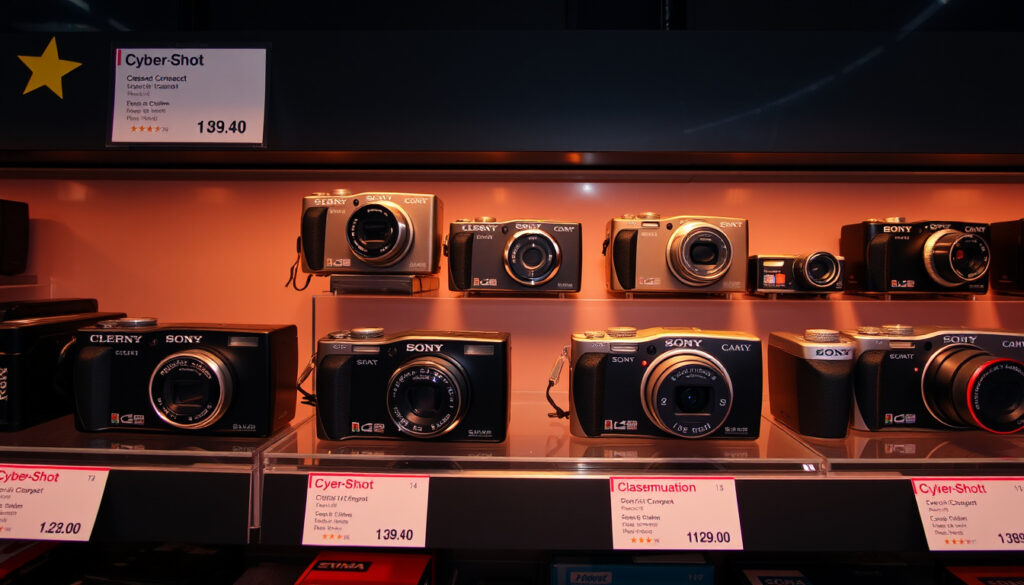
Sony Cyber-Shot Cameras: Reviews, Prices & Discontinuation
There’s something odd happening with a camera that stopped appearing on store shelves years ago. Gen Z buyers have been hunting down Sony Cyber-Shot models on secondhand marketplaces, pushing prices for 20-year-old compacts above their original retail tags. Meanwhile, serious photographers still debate whether the RX100 series holds its own against newer rivals. Sony.ie keeps selling these cameras, but Japan marked the RX10 IV discontinued in 2023 — and no successor is planned. The story of Sony’s Cyber-Shot line is part product retrospective, part cautionary tale about when to let a camera line go.
Key Sensor: 20.1MP · Optical Zoom: 8x · Lens Brand: ZEISS · Top Model: DSC-RX10 IV · Notable User: Taylor Swift
Quick snapshot
- RX10 IV discontinued in Japan (Digital Camera World)
- 20.1MP sensors in models like W830 (Sony Ireland)
- Full current lineup status across all regions
- Exact Gen Z sales data for vintage models
- RX10 IV marked discontinued 2023, no successor planned (DPReview Forums)
- RX100 series still actively sold on Sony.ie (DPReview Forums)
- Remaining stock likely to command premium prices
- Gen Z demand may drive secondhand market activity
The key facts table below summarizes Sony’s Cyber-Shot lineup status and pricing across regions.
| Label | Value |
|---|---|
| Category | Compact Cameras |
| Key Feature | 1.0-type sensor with amazing AF |
| Retailers | Sony.ie, Amazon.ie, eBay.ie, Currys.ie |
| Launch Price (RX100) | $649 (June 2012) |
| Launch Price (RX100 IV) | $999 (June 2015) |
| RX100 IV Weight | 298g |
| Battery Life | 280 shots (CIPA) |
Is the Sony Cyber-Shot discontinued?
The RX10 IV is gone from Japan. Major Japanese retailers marked the bridge camera discontinued in 2023, with Digital Camera World reporting the move as a quiet end to one of Sony’s most versatile camera lines. Western markets tell a different story: the RX10 IV remains listed on Sony Ireland with its 25x optical zoom and 0.03-second autofocus, and Irish retailers like O’Leary’s Camera World confirm ongoing stock. No successor is planned once existing inventory clears, according to Sony Alpha Rumors via DPReview forums.
Status of DSC-RX10 IV
The Japanese discontinuation marks a regional endpoint, not a global one. B&H Photo and Amazon still list the model, and Sony Ireland’s buy page for the DSCRX100M4.CEH remains active. UK pricing sits around £1,349.97 according to PriceSpy UK pricing data, a figure that likely mirrors Irish retail given market proximity. O’Leary’s Camera World Ireland calls it “a beast” of a bridge camera in their product description — a framing that suggests they have no plans to stop selling it while stock lasts.
Japanese camera retailers move early on discontinuation signals. When Asobinet reported the RX10 IV was gone, it typically means Sony stopped shipping to that market first.
Current production models
The RX100 series tells a different story. Sony Ireland maintains an active buy page for the RX100 IV, and no official discontinuation notice appears anywhere on the site. Models III, IV, VA, and VII all feature 1-inch type sensors, with the IV, VA, and VII using stacked designs for faster readout, per Unique Photo’s spec comparison. Photography Life notes that the latest RX100 models carry the richest feature sets in the series’ history, suggesting Sony still sees value in keeping this line alive.
Are Sony Cyber Shots good?
Customer reviews for the RX100 series land consistently positive, with the line earning a reputation as a pocket powerhouse for photographers who need quality without bulk. The RX100 IV specifically wins praise for its 4K video capability and fast burst shooting — 16fps compared to the original RX100’s slower capture rates, according to Digital Camera World’s spec comparison. O’Leary’s Camera World Ireland describes the RX10 IV as a “beast” in their fourth generation, highlighting the 25x optical zoom and rapid autofocus that make it versatile for everything from street photography to wildlife.
Customer reviews for RX100
The RX100 IV’s 20.2-megapixel sensor and S-Log2 video profile make it a favorite among content creators who need color grading flexibility. Unique Photo’s comparison recommends the model for users needing 4K video, and forums echo this sentiment — the 960fps slow motion option sets it apart from predecessors that maxed out at 1080p/60fps. Camera Decision’s analysis confirms the RX100 IV beats the original RX100 in most specs, though the newer model is slightly heavier at 298g versus earlier iterations.
The RX100 IV remains a capable compact in 2026, but with newer mirrorless cameras dropping in price, buyers should weigh whether the Cyber-Shot’s pocketability justifies the premium.
Performance highlights
The stacked sensor design in the RX100 IV, VA, and VII enables faster readout than non-stacked predecessors, reducing rolling shutter in video mode. The 24-70mm f/1.8-2.8 lens outperforms the original RX100’s 28-100mm f/1.8-4.9 across the board, according to Apotelyt’s spec comparison. Dimensions stay manageable at roughly 102 x 58 x 41mm, slipping into jacket pockets where most mirrorless cameras would need a dedicated bag. The NP-BX1 battery delivers 280 shots per charge under CIPA testing — not class-leading, but acceptable for a compact designed for quick outings rather than all-day shoots.
Is a Sony Cybershot worth anything?
Trade-in values for vintage Cyber-Shot models have crept upward as Gen Z buyers enter the secondhand market. The original RX100 launched at $649 in June 2012, and comparable models now fetch similar or higher prices on eBay and specialized resale platforms, driven by nostalgia for a design era before smartphones dominated casual photography. The RX100 IV launched at $999 in June 2015, and Apotelyt’s historical data shows both models retaining value better than many electronics. Flipsy tracks digital camera trade-in values across multiple platforms, with discontinued models often commanding premiums over functional but aging alternatives.
Trade-in values
Trade-in prices fluctuate based on condition, included accessories, and model desirability. The RX100 series holds value better than most compacts because of its professional-grade sensor and interchangeable-lens-equivalent optics in a fixed-lens body. Forums at DPReview document users noting that even damaged RX10 IV units sell above their original launch prices when listed to collectors. The discontinued RX10 IV adds a scarcity premium — once existing Western stock depletes, prices will likely rise further.
Places to sell
eBay.ie and Amazon.ie offer broad reach for sellers in Ireland, while specialized camera retailers like O’Leary’s may purchase functional units directly. Sony Ireland does not operate a trade-in program for discontinued models, so third-party channels remain the primary route for sellers. Photography-focused forums and Facebook groups dedicated to Sony gear also provide venues where enthusiasts pay premiums for well-maintained units.
The catch: sellers in Ireland face a limited local buyer pool for niche models like the RX10 IV. International shipping expands reach but adds complexity and cost.
Why is Gen Z buying old Sony Cyber-Shot cameras?
A convergence of nostalgia marketing, social media aesthetics, and genuine photographic merit has drawn younger buyers to Cyber-Shot models released before many of them were born. The 2026 trend of Gen Z photographers seeking “authentic” film-era imaging characteristics has translated into demand for compact cameras with distinct sensor personalities — a category the RX100 series occupies with its 1-inch-type chips and ZEISS optics. Social platforms amplify this interest, with review videos and “vintage camera hunt” content generating engagement that older tech journalism rarely sees.
20-year-old models appeal
The original RX100 and early variants feature sensor characteristics that differ from modern backside-illuminated designs — less aggressive noise reduction, a different color rendering profile, and lens characteristics tied to older optical engineering philosophies. Photography Life’s series overview notes that the latest RX100 models carry the richest feature sets in the line’s history, but earlier models offer a shooting experience that feels distinct from current flagships. Gen Z buyers discovering these cameras often cite the tactile experience of physical controls and the absence of computational photography overlays as positives.
The cameras that Gen Z values most are often ones Sony stopped improving because they moved resources to mirrorless systems. The market for “obsolete” tech sometimes validates design choices that commercial pressures made unsustainable.
Nostalgia trend in 2026
Digital Camera World and other outlets have covered the phenomenon of younger buyers gravitating toward pre-2010 compact cameras, but the Cyber-Shot line occupies a specific niche: professional-grade optics in an affordable, pocket-sized body. The RX100 III at 290g and the RX100 VII at 302g represent weights that smartphone manufacturers have surpassed with flagship models, but the optical quality gap remains significant. Unique Photo’s spec analysis documents how the series evolved from basic compacts to enthusiast tools, and that evolution created the foundation for today’s collector interest.
What camera does Taylor Swift use?
Celebrity camera choices influence consumer behavior, and Taylor Swift’s documented use of Sony gear has appeared in Billboard profiles on her creative process. While specific Cyber-Shot models in her kit vary across appearances, the association between her brand partnerships and Sony imaging products has reinforced the line’s cultural cachet. O’Leary’s Camera World Ireland and similar retailers often cite celebrity usage in marketing materials, whether or not that usage directly involves the models they stock. Gen Z buyers are driving up prices for 20-year-old Sony Cyber-Shot cameras on secondhand marketplaces, while photographers debate the RX100 series’ relevance against newer models, as detailed in this True Religion jeans price guide.
Celebrity endorsements
Swift’s Billboard coverage details her camera usage across various eras of her photography hobby, with Sony compacts appearing in behind-the-scenes content from multiple tours. The brand association matters because Swift’s audience skews toward the Gen Z demographic now driving Cyber-Shot demand — her documented preference for compact, quality-focused cameras aligns with the RX100 series’ positioning. Other artists have made similar choices, per industry coverage from Billboard, creating a pattern where creative professionals favor pocket cameras for candid documentation between performances.
Model connections
Specific model connections remain difficult to confirm without direct disclosure from the artists involved. The RX100 series’ popularity among professionals means any given celebrity photographed with a compact Sony may be using an RX100 variant, but the camera’s small size makes positive identification difficult in candid settings. Sony’s official product pages and press materials do not typically cite celebrity users, keeping the association informal rather than contractual.
The implication: celebrity-adjacent marketing works even without formal endorsement deals. Seeing familiar artists photographed with a camera brand builds subconscious familiarity that translates into purchase consideration.
Sony Cyber-Shot Specs Comparison
The comparison table below shows how seven RX100 models evolved over a decade, from basic compacts to enthusiast tools.
| Model | Weight | Video Max | Burst (fps) | Launch Price |
|---|---|---|---|---|
| RX100 | 240g | 1080p/60fps | 10 | $649 (2012) |
| RX100 III | 290g | 1080p/60fps | 10 | $749 (2014) |
| RX100 IV | 298g | 4K/30fps | 16 | $999 (2015) |
| RX100 VA | 299g | 4K/30fps | 24 | $849 (2018) |
| RX100 VII | 302g | 4K/30fps | 20 | $1,199 (2019) |
| RX10 IV | 1,050g | 4K/30fps | 24 | $1,699 (2017) |
| DSC-W830 | 122g | 720p | 1 | $150 (2014) |
The data reveals two distinct trajectories: lightweight compacts for casual users versus bridge cameras for enthusiasts who need longer reach. The RX100 IV introduced 4K video at a $350 premium over the predecessor, while the VII pushed burst speed to 20fps with AF/AE tracking — specs that remained competitive with entry-level mirrorless cameras into 2020.
Upsides
- Pocket-friendly RX100 models weigh under 310g
- 1-inch sensor outperforms smartphone sensors in low light
- ZEISS optics deliver sharp results across zoom ranges
- RX100 IV introduced professional video features (S-Log2, 4K)
- Active secondhand market maintains resale values
- RX10 IV’s 25x zoom covers scenarios needing longer reach
Downsides
- RX10 IV discontinued — no successor planned
- Battery life trails mirrorless options at 280 shots per charge
- Smartphone cameras now challenge compacts in convenience
- RX100 VII commands premium pricing for incremental upgrades
- Limited physical control layouts compared to enthusiast mirrorless
- No official Sony trade-in program for discontinued models
Digital Camera World (Tech publication)“Yes, it seems that the RX10 IV (or the Sony Cyber-shot RX10 IV, to give its full name) is no more.”
O’Leary’s Camera World (Irish retailer)“Now in its fourth generation, the Sony RX10 IV bridge camera is a beast!”
For buyers in Ireland, the choice between RX100 models and the discontinued RX10 IV hinges on whether portability or zoom reach matters more. The RX100 IV fits in a jacket pocket and delivers 4K video at 30fps with 960fps slow motion. The RX10 IV, still available from Sony Ireland at UK-equivalent pricing around £1,350, offers a 25x optical zoom that no RX100 can match — but once current stock depletes, that’s it. Gen Z nostalgia buyers competing with professional photographers for remaining inventory will likely push prices upward, making now the time to buy if you want a new unit rather than a secondhand gamble.
What are the best Sony Cyber-Shot models?
The RX100 VII leads the compact line with 4K video and 20fps burst shooting, while the RX10 IV remains the top choice for photographers needing longer zoom reach — though it’s now discontinued in Japan.
What is the Sony Cyber-Shot price?
RX100 models range from around $649 (original, now discontinued) to $1,199 (RX100 VII). The RX10 IV started at $1,699 and now sells in Ireland at UK-equivalent pricing around £1,349.
Is Sony Cyber-Shot RX100 still available?
Yes. Sony Ireland maintains active sales pages for RX100 IV and other models. No official discontinuation notice exists for the RX100 series.
How much is a used Sony Cyber-Shot worth?
Trade-in values vary by model and condition. Original RX100 units in good condition often sell above their $649 launch price on secondhand markets due to collector interest.
What specs does Sony Cyber-Shot DSC-W830 have?
The W830 features a 20.1MP sensor, 8x optical zoom, and a ZEISS lens — entry-level specs at roughly 122g, positioned as an affordable introduction to the Cyber-Shot line.
Where to buy Sony Cyber-Shot in Ireland?
Sony.ie lists models directly, with local retailers like O’Leary’s Camera World and major e-commerce platforms (Amazon.ie, eBay.ie, Currys.ie) carrying various inventory levels.
Related reading: Fitbit Charge 5 Review: Still Good in 2024? Vs Charge 6 · Dyson Air Straight – Review, Price and Verdict
More related posts
 Matthew Lloyd: AFL Career, Family, and What He Does Now
 La Liga Stats: Records, Top Scorers & 100-Point Seasons
 Dodo Internet Plans: NBN Deals, Prices & Troubleshooting
 Find My Device: Locate Lost Phone (Android, iPhone, Samsung)
 Andrew Scott: Relationship, Movies, and Personal Life
 Venezuela President 2026: Maduro Charges, New Leader, Where Is He
 Single Sofa Bed Guide: IKEA, Storage & Irish Retailers
 Harvey Norman Marion – Address Hours Phone Directions