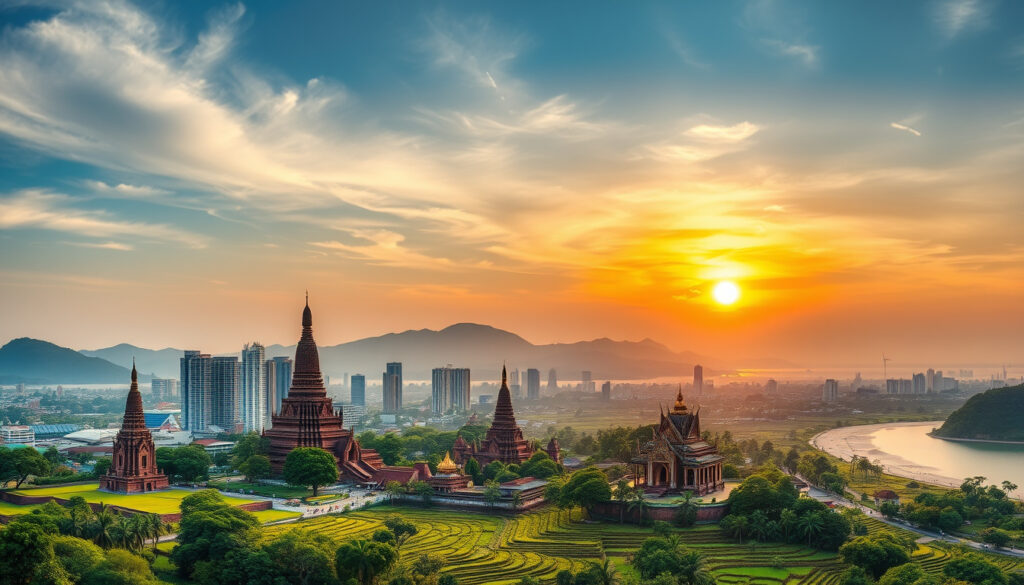
Southeast Asia: 11 Countries, Comparisons & Quality of Life
Anyone who’s tried to name all the countries in Southeast Asia from memory knows it’s trickier than it looks. The region spans a sprawling archipelago and a mainland strip, home to more than 655 million people and economies that range from high-tech city-states to emerging agricultural nations.
Number of countries: 11 · Total area: 4.5 million km² · Population (2020): 655 million · Combined GDP (PPP): $9.7 trillion · Largest economy: Indonesia · Most populous country: Indonesia
Quick snapshot
- Southeast Asia comprises 11 nations (Wikipedia overview)
- China and Pakistan are not part of the region (Britannica)
- Singapore ranks as the wealthiest country per capita (World Bank)
- Precise GDP PPP for North Korea due to limited data (World Bank)
- Official quality-of-life rankings for several smaller Southeast Asian nations (Numbeo (crowdsourced))
- Whether Timor-Leste or Myanmar is the poorest in the region depends on the metric used (World Bank PPP data)
- No major regional border or sovereignty changes in recent decades; ASEAN remains the primary multilateral forum (ASEAN official site)
- ASEAN Digital Masterplan 2025 and infrastructure projects may shift economic balances (ASEAN Digital Masterplan)
- Quality-of-life rankings likely to evolve as Myanmar’s political crisis deepens (Human Rights Watch)
The key facts table below compiles the region’s size, population, and economic heft into one reference.
| Attribute | Value |
|---|---|
| Number of countries | 11 (Brunei, Cambodia, Indonesia, Laos, Malaysia, Myanmar, Philippines, Singapore, Thailand, Timor-Leste, Vietnam) |
| Total land area | 4,464,000 km² (1,723,000 sq mi) |
| Population (2020 est.) | 655 million |
| Combined GDP (PPP, 2024) | $9.7 trillion |
| Largest economy (nominal GDP) | Indonesia ($1.4 trillion, IMF 2024) |
| Wealthiest per capita | Singapore ($88,450 PPP, IMF 2024) |
| Most populous country | Indonesia (278 million) |
| Primary international body | ASEAN (Association of Southeast Asian Nations) |
| Dominant religions | Islam, Buddhism, Christianity, Hinduism |
| Major languages | Indonesian, Thai, Vietnamese, Tagalog, Burmese, Malay, Khmer, Lao |
What are the 11 countries in Southeast Asia?
Complete list of Southeast Asian nations
Eleven countries make up the region recognized by the United Nations as Southeast Asia. They are, in alphabetical order: Brunei, Cambodia, Indonesia, Laos, Malaysia, Myanmar, Philippines, Singapore, Thailand, Timor-Leste, and Vietnam.
These nations share common membership in ASEAN, though Timor-Leste remains an applicant state as of 2024 (ASEAN member states).
A traveler or investor planning a trip to Southeast Asia will encounter 11 distinct countries, each with its own visa regime, currency, and cultural norms—not a single block.
Is China part of Southeast Asia?
No. China is a North‑East Asian country, not a Southeast Asian one. The United Nations geoscheme places China in Eastern Asia alongside Japan, Mongolia, North Korea, South Korea, and Taiwan (UN M49 classification). Geographically, China lies entirely north of the Southeast Asia peninsula.
Is Pakistan in Southeast Asia?
No. Pakistan belongs to South Asia. The South Asian Association for Regional Cooperation (SAARC) counts Pakistan among its eight members, which also include Afghanistan, Bangladesh, Bhutan, India, Maldives, Nepal, and Sri Lanka (SAARC official site). The confusion may arise because both South and Southeast Asia are part of the broader “Asia” continent, but they are distinct subregions with separate political and cultural histories.
What this means: Any map or dataset that includes China or Pakistan under “Southeast Asia” is geographically incorrect. Stick to the UN’s M49 standard or the ASEAN membership list for authoritative boundaries.
What’s the difference between East Asia and Southeast Asia?
Geographic boundaries and subregions
East Asia stretches from the Pacific coast of China northward to Mongolia and east to Japan and the Korean Peninsula. Southeast Asia lies south of China and east of the Indian subcontinent, covering both mainland Indochina and the maritime archipelago (Britannica on East Asia). A quick mental boundary: the Tropic of Cancer roughly separates the two, though the line is not official.
Countries included in each region
The six core East Asian countries are: China, Japan, Mongolia, North Korea, South Korea, and Taiwan (disputed status but consistently classified under East Asia). Southeast Asia, as noted, comprises 11 states. The two lists do not overlap—no country belongs to both.
Cultural and economic distinctions
East Asian economies are generally more industrialized and have higher GDP per capita, with Japan, South Korea, and wealthy Chinese cities leading. Southeast Asia is more mixed: Singapore’s GDP per capita ($88,450 PPP) rivals that of Japan, while countries like Myanmar and Timor-Leste remain low-income (IMF World Economic Outlook). Culturally, East Asia is dominated by Confucian, Buddhist, and Shinto traditions, while Southeast Asia blends Theravada Buddhism, Islam, and indigenous animist practices.
The pattern: East Asia is more homogeneous in income level and cultural framework; Southeast Asia is far more diverse—economically, religiously, and linguistically.
Which is the no. 1 poorest country in Asia?
Methodology of GDP PPP rankings
International organizations such as the World Bank and IMF use Gross Domestic Product adjusted for purchasing power parity (GDP PPP) as a standard metric for cross‑country poverty comparisons. The lowest‑ranked country usually reflects conflict, isolation, or limited natural resources.
Current poorest Asian country
Among UN‑recognized sovereign states, Afghanistan is widely cited as the poorest in Asia, with a GDP PPP per capita of roughly $1,500 in 2024 (World Bank PPP data). North Korea’s lack of reliable data makes it hard to rank, but estimates place it near the bottom.
Southeast Asia’s poorest nations
Within Southeast Asia, Timor-Leste and Myanmar vie for the lowest GDP PPP per capita. According to IMF data, Timor-Leste’s GDP PPP per capita is about $3,300, while Myanmar’s hovers around $4,700 (IMF October 2024 database). Both are well below the regional average of $15,000.
Poverty rankings depend heavily on which metric is used—GDP PPP, GDP nominal, or the Multidimensional Poverty Index (MPI). Timor‑Leste may appear poorer in nominal terms but has lower inequality than Myanmar.
Why this matters: For donors and NGOs, knowing which country ranks lowest helps prioritize aid. But a single number hides deep nuance—Myanmar’s ongoing civil war may already have made it the region’s poorest in real terms.
Which country has the best quality of life in Asia?
Quality-of-life indices used
The Economist Intelligence Unit’s Global Liveability Index (EIU 2024) scores cities on stability, healthcare, culture, education, and infrastructure. Numbeo’s crowdsourced Quality of Life Index (Numbeo Southeast Asia) adds purchasing power, safety, and pollution metrics. For those interested in Southeast Asia, you can find more details on the giá vàng thế giới.
Top destinations for expats and travelers
In the EIU’s 2024 index, Osaka (Japan), Tokyo, and Singapore tie among the top five globally. U.S. State Department travel advisories (Singapore Level 1, Japan Level 1) reflect high safety in both East Asian and Southeast Asian top scorers.
Southeast Asian contenders
According to Numbeo’s regional rankings, Singapore leads Southeast Asian cities with a Quality of Life Index of 160.7, followed by Kuala Lumpur (141.4) and Chiang Mai (140.1). Singapore also posts a safety index of 75.6 and a purchasing power index of 98.4 (Numbeo data). For comparison, Ho Chi Minh City scores 75.8 on quality of life but a pollution index of 92.5—a stark trade‑off.
Numbeo’s index data reveals the wide gap between top and bottom Southeast Asian cities.
| City | Quality of Life Index (Numbeo) | Safety Index | Pollution Index |
|---|---|---|---|
| Singapore | 160.7 | 75.6 | 43.2 |
| Kuala Lumpur | 141.4 | 39.7 | 60.4 |
| Chiang Mai | 140.1 | 77.6 | 48.5 |
| Bangkok | 96.7 | 45.2 | 77.8 |
| Jakarta | 91.3 | 35.1 | 81.0 |
| Ho Chi Minh City | 75.8 | 43.5 | 92.5 |
| Tokyo (benchmark) | 176.5 (global rank 1) | 81.0 | 38.6 |
The trade-off: Southeast Asia offers lower costs and warmer climates, but East Asian cities consistently beat them on infrastructure and safety. Expats who prioritize cleanliness and low crime often pick Singapore; those who want lower living costs prefer Chiang Mai or Kuala Lumpur.
What is the richest sea country?
Definition of ‘richest sea country’
A “sea country” is a maritime nation—one with a coastline and significant ocean‑based economy. In Southeast Asia, every country except Laos (landlocked) qualifies. Wealth can be measured by total GDP, GDP per capita, or ocean‑economy value.
Southeast Asian wealth leaders
In absolute GDP, Indonesia is the region’s largest economy at $1.4 trillion, driven by fisheries, shipping, and offshore oil (World Bank Indonesia). But per capita, Singapore is the undisputed richest, with GDP per capita (PPP) exceeding $88,000—more than double the next highest, Brunei, at about $62,000 (IMF data).
Comparison of GDP and wealth per capita
IMF data for 2024 draws a clear contrast between total economic scale and per-capita affluence.
| Country | Nominal GDP (2024) | GDP per capita (PPP, 2024) |
|---|---|---|
| Singapore | $503 billion | $88,450 |
| Brunei | $16 billion | $62,000 |
| Malaysia | $465 billion | $39,000 |
| Thailand | $548 billion | $23,000 |
| Indonesia | $1.4 trillion | $16,000 |
| Philippines | $435 billion | $10,000 |
| Vietnam | $450 billion | $14,000 |
The implication: If “richest sea country” means the highest standard of living for its citizens, Singapore wins by a wide margin. If it means the largest overall maritime economy, Indonesia takes the title.
“Singapore combines high infrastructure quality with strong safety and healthcare outcomes, making it a perennial top-five city in the Global Liveability Index.”
Economist Intelligence Unit, Global Liveability Index 2024 (EIU official report)
“The U.S. Department of State rates Singapore and Thailand at Level 1 (Exercise Normal Precautions), reflecting the lowest advisory level for safety and security.”
U.S. Department of State travel advisories (Singapore & Thailand)
The richest sea country by total GDP (Indonesia) is also among the most polluted and traffic‑congested, while the richest per capita (Singapore) is a tiny city‑state with almost no natural resources beyond its port.
Related reading: Things to Do in Tokyo: Top Attractions & Itineraries · Vietnamese Near Me – Best Pho and Banh Mi in Panama City Beach
youtube.com, internationalliving.com, storymaps.arcgis.com, lan-portal.uob.edu.ly, silverairways.com
För den som vill jämföra Sydostasiens länder med resten av kontinenten finns en detaljerad karta över Asien som visar alla länders huvudstäder och nyckelstatistik.
Frequently asked questions
Do all 11 Southeast Asian countries belong to ASEAN?
All except Timor-Leste, which holds applicant status. ASEAN (Association of Southeast Asian Nations) is the primary regional bloc.
How do historical influences differ between East and Southeast Asia?
East Asia was shaped largely by Chinese dynasties and Confucianism; Southeast Asia absorbed Indian, Chinese, Islamic, and European colonial influences, producing greater cultural variety.
How does Afghanistan compare to Timor-Leste in poverty metrics?
Afghanistan’s GDP PPP per capita is roughly $1,500, well below Timor-Leste’s $3,300. Both face conflict-driven economic collapse.
What specific quality-of-life metrics put Singapore ahead of Tokyo?
Singapore’s Numbeo Quality of Life Index (160.7) trails Tokyo (176.5), but Singapore leads Southeast Asian cities in safety (75.6) and purchasing power (98.4).
How does Singapore’s per-capita wealth compare to Indonesia’s total GDP?
Singapore’s GDP per capita (PPP) of $88,450 dwarfs Indonesia’s $16,000, but Indonesia’s $1.4 trillion nominal GDP makes it the largest maritime economy in the region.
Why is Taiwan classified as East Asia and not Southeast Asia?
The UN geoscheme places Taiwan in Eastern Asia alongside China, Japan, and the Koreas, based on geographic and cultural alignment.
What are the key cultural differences between South and Southeast Asia?
South Asia is predominantly Hindu and Muslim with deep caste influences; Southeast Asia is majority Muslim and Buddhist with strong indigenous animist traditions.
What are the 7 countries in South Asia?
Afghanistan, Bangladesh, Bhutan, India, Maldives, Nepal, Pakistan, and Sri Lanka (eight total, though definitions vary).
For anyone navigating travel, business, or academic comparisons in Asia, the boundaries between Southeast, East, and South Asia are far from academic—they shape visa policies, economic partnerships, and cultural expectations. The clearest takeaway: Southeast Asia’s 11 countries are united by ASEAN but divided by income, religion, and development level. An investor deciding between a high‑trust, high‑cost location like Singapore and a lower‑cost, higher‑risk market like Myanmar must choose which trade‑off fits their timeline.
More related posts
 Osiris God: Myth, Family, Symbols & Role in Egyptian Afterlife
 Taylor Dearden: Neurodivergence, Family & Career Facts
 Jeff Bezos: Net Worth, Age, Height, Ethnicity, and More
 Time in Philippines Now: Live Clock & UK Time Difference
 Tom Jones in 2025: Health, Partner, and Family Updates
 King Edward VII: Biography, Reign, Marriage, and Death
 Scarlet Vas: Neighbours Star Marries Stepbrother, Welcomes Child
 Iga Swiatek: Relationship, Faith, Accusations, Career Stats