James Dean Death: Last Words, Cause, Car Crash & Legacy
There are very few Hollywood stories that still send a chill down the spine like the one about James Dean. A young actor with only three starring roles to his name somehow became a symbol of rebellion that has lasted nearly 70 years. What really happened on that California highway in 1955, and why did that single moment define a legacy far bigger than his actual filmography? This article separates the confirmed facts from the rumors that still swirl around his death.
Born: February 8, 1931, Marion, Indiana ·
Died: September 30, 1955, near Paso Robles, California ·
Age at Death: 24 years old ·
Number of Films Lead: 3 (East of Eden, Rebel Without a Cause, Giant) ·
Car in Fatal Crash: Porsche 550 Spyder, nicknamed “Little Bastard”
Quick snapshot
- Dean died on September 30, 1955, from a broken neck after colliding with a Ford Tudor (Wikipedia – Death of James Dean)
- He was driving a Porsche 550 Spyder on the way to a sports car race in Salinas (Encyclopaedia Britannica (reference work))
- Exact last words — multiple contradictory accounts exist (Los Angeles Times (major U.S. newspaper))
- Whether Dean was speeding at 90 mph or closer to 55 mph at impact (Biography.com (celebrity biography archive))
- Whether Dean had a premonition of dying young (Biography.com (celebrity biography archive))
- Crash occurred around 5:45–5:56 p.m. on Highway 46, about 19 miles east of Paso Robles (History.com (historical encyclopedia))
- Dean had been ticketed for speeding earlier that same afternoon (History.com (historical encyclopedia))
- Dean became a posthumous icon with two Academy Award nominations for films released after his death (Wikipedia – James Dean)
- The crash site on Highway 46 remains a pilgrimage spot for fans (Los Angeles Times (major U.S. newspaper))
Seven key facts capture the man and the moment in a single glance.
| Attribute | Value |
|---|---|
| Full Name | James Byron Dean |
| Born | February 8, 1931, Marion, Indiana, USA |
| Died | September 30, 1955, Paso Robles, California, USA |
| Cause of Death | Automobile accident (broken neck) |
| Height | 5 ft 8 in (1.73 m) |
| Notable Films | East of Eden, Rebel Without a Cause, Giant |
| Academy Awards | Two posthumous nominations (Best Actor) |
What happened to James Dean?
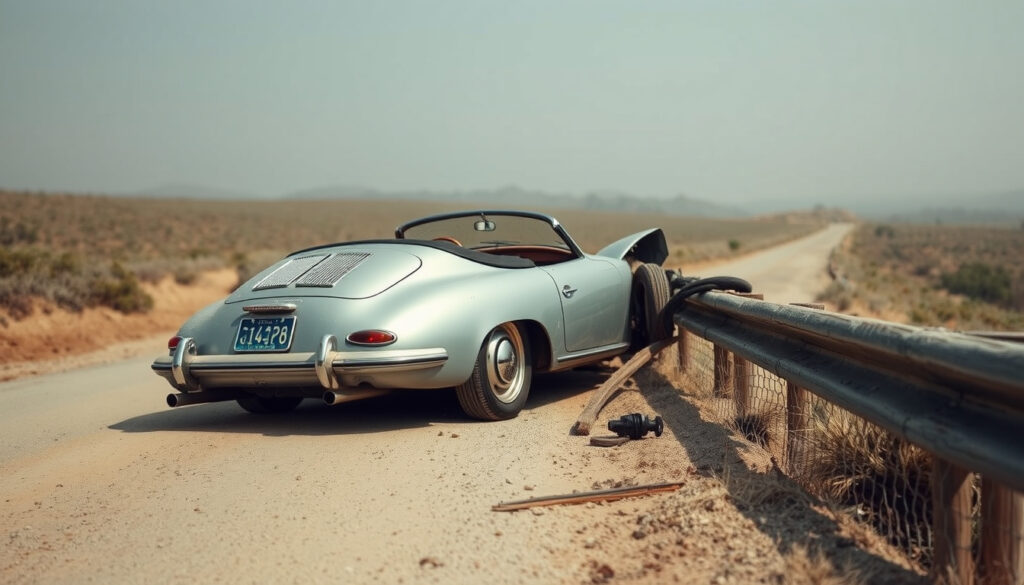
The story of James Dean’s death is a short, brutal sequence of events that unfolded on a quiet stretch of California highway. On September 30, 1955, Dean was driving his silver Porsche 550 Spyder (Encyclopaedia Britannica) toward a sports car race in Salinas. He had already been pulled over earlier that afternoon by a California Highway Patrol officer for doing 65 mph in a 55 mph zone, as History.com (historical encyclopedia) reports.
The collision happened around 5:45 to 5:56 p.m. at the junction of U.S. Route 466 and State Route 41 — now Highway 46 and Highway 41 — about 19 miles east of Paso Robles, according to the Los Angeles Times (major U.S. newspaper). Dean’s Porsche struck a 1950 Ford Tudor sedan that was making a left turn. The other driver was Donald Turnupseed (Biography.com), a 23-year-old Cal Poly student who walked away with minor injuries. Dean’s passenger, Rolf Wütherich (DW, German public broadcaster), was thrown from the car and survived. Dean died at the scene from a broken neck.
A 24-year-old actor with exactly one released feature film was dead before sunset. Yet the crash itself — mundane, rural, a simple intersection — became the most famous act of his career.
What did James Dean hit when he died?
Dean’s Porsche 550 Spyder collided with a 1950 Ford Tudor (History.com) driven by Donald Turnupseed, who was turning left across Dean’s lane. The Ford’s front end was crushed, but Turnupseed survived with minor cuts.
Who was responsible for James Dean’s death?
An inquest ruled the crash accidental. Biography.com (celebrity biography archive) notes that fault was attributed to Dean’s failure to yield, and no formal charges were filed. Some later reporting has questioned the speeds involved, with estimates varying from the widely cited 90 mph down to around 55 mph. The uncertainty remains unresolved.
“I never saw him. I just started my turn and then there was this crash.” — Donald Turnupseed, as quoted in the Los Angeles Times
Where did James Dean die?
The crash happened on a rural stretch of road near Cholame (History.com), roughly 19 miles east of Paso Robles, California. The intersection is now a memorial site where fans leave tributes.
What were James Dean’s last words before he died?
The last words attributed to James Dean have become almost as famous as his films — but the exact phrasing depends on which account you trust. The most commonly cited version, reported by Reader’s Digest (general interest magazine), has Dean saying, “That guy’s gotta stop… he’ll see us.” Passenger Rolf Wütherich was the source of that account.
“That guy’s gotta stop… he’ll see us.” — Rolf Wütherich, as quoted in Reader’s Digest
A different version appeared in the Los Angeles Times (major U.S. newspaper), quoting Dean’s words as “He’s gotta see us.” The discrepancy comes from the chaos of the moment: Wütherich was thrown from the car and may have misremembered. No other living witness corroborated the exact words. The final phrase remains unconfirmed.
Why is James Dean so famous?
By the time of his death, Dean had only one film in theaters — East of Eden, released in March 1955. Rebel Without a Cause premiered one month before the crash. Giant came out the following year. He became a cultural phenomenon after he was gone. Biography.com (celebrity biography archive) puts it plainly: Dean became a symbol of teenage angst and rebellion precisely because his life ended before he could grow old.
His method acting style, influenced by Marlon Brando and Lee Strasberg, set a new standard. Two posthumous Academy Award nominations for Best Actor — one for East of Eden and another for Giant — secured his place in film history. But the real engine of his fame was timing: he died at the exact moment American youth culture was looking for a figure to personify its restless energy.
How did James Dean become famous?
Dean’s path to fame started in New York, where he studied at the Actors Studio and worked in television. His first major role was in East of Eden (1955), which earned him immediate critical acclaim. Rebel Without a Cause (1955) locked in his image as the troubled teenager, and Giant (1956) showed his range alongside Elizabeth Taylor and Rock Hudson.
What is James Dean’s legacy?
Wikipedia – James Dean describes him as “one of the most influential actors of the 20th century.” His death scene Rebel Without a Cause has been referenced in everything from Weird Science to The Simpsons. Actors like Leonardo DiCaprio and Johnny Depp cite him as an inspiration. The twist: his legacy rests on three films and a car crash, not a long body of work.
Dean’s fame is a perfect feedback loop: his death made him an icon, and being an icon made his three films permanent classics. Film students: the lesson is that absence, not abundance, built the legend.
Who was James Dean’s male lover?
This question circulates constantly online, driven by rumors of a relationship with actor Marlon Brando (Wikipedia – James Dean). The reality: no definitive documentation exists. Dean and Brando had a close friendship, and Brando was a major influence on Dean’s acting style. Some biographers suggest Dean had relationships with both men and women, but no named partner has been confirmed with primary source evidence.
What was James Dean’s relationship with Marlon Brando?
Dean admired Brando and sought his mentorship. They met several times and reportedly had an intense personal chemistry Wikipedia – James Dean. Brando later dismissed talk of a romantic relationship in his autobiography. The question remains open because no letters, photos, or third-party accounts provide proof either way.
Did James Dean have any known romantic partners?
Dean was linked romantically to several women, including actress Pier Angeli and Italian actress Anna Maria Pierangeli. He was also known to have had a close friendship with actor Jack Simmons. The absence of confirmed documentation about a male lover means the rumors stay in the category of speculation.
What were James Dean’s most famous movies?
Dean’s entire leading filmography fits on one hand. His three starring roles are East of Eden (1955), Rebel Without a Cause (1955), and Giant (1956). He also appeared in several television episodes and short films through the early 1950s. For a man who died at 24, the output is small but the impact is huge.
What movies did James Dean star in?
| Film | Year | Role | Notes |
|---|---|---|---|
| East of Eden | 1955 | Cal Trask | First starring role; Oscar nomination |
| Rebel Without a Cause | 1955 | Jim Stark | Released one month before his death |
| Giant | 1956 | Jett Rink | Posthumous release; Oscar nomination |
What was James Dean’s height and age?
Dean stood 5 feet 8 inches (1.73 m) tall (Wikipedia – James Dean). He was born on February 8, 1931, and died at age 24. His height often surprises people who imagine him taller — the big screen makes a small man look larger.
Timeline of James Dean’s life and death
The critical milestones, from birth to posthumous Oscar nominations, show how compressed his story really is.
- February 8, 1931: Born in Marion, Indiana. (Wikipedia – James Dean)
- 1949: Moved to California to pursue acting. (Biography.com (celebrity biography archive))
- 1951: First TV appearance; studied at UCLA. (History.com (historical encyclopedia))
- 1954: Cast in East of Eden — breakthrough role. (Encyclopaedia Britannica (reference work))
- 1955 (March): Rebel Without a Cause released. (Biography.com (celebrity biography archive))
- 1955 (September 30): Died in car crash on Highway 46. (Los Angeles Times (major U.S. newspaper))
- 1956 (posthumous): Giant released; earned an Academy Award nomination. (Wikipedia – James Dean)
What the crash means today
Sixty-eight years after a silver Porsche crumpled against a Ford Tudor at an unmarked intersection, James Dean still draws pilgrims. For the film industry, his story is a warning about the fragility of fame. For audiences, it is a reminder that the movies we love are often shaped by the lives cut short making them.
The real takeaway is not the disputed last words or the question of responsibility. It is that Dean’s three films — East of Eden, Rebel Without a Cause, and Giant — remain genuinely excellent. The crash made him a symbol, but the work made him an actor. For anyone discovering him today, start with Rebel Without a Cause. Then ask yourself: what would he have done with another forty years?
For those who want to dig deeper into the details, the full story of his death offers a thorough account.
Frequently asked questions
What was James Dean’s cause of death?
He died from a broken neck suffered in a car collision on September 30, 1955 (Wikipedia – Death of James Dean).
How old was James Dean when he died?
24 years old (History.com).
What car did James Dean crash?
A 1955 Porsche 550 Spyder nicknamed “Little Bastard” (Encyclopaedia Britannica).
How many movies did James Dean make?
Three starring films: East of Eden, Rebel Without a Cause, and Giant (Biography.com).
Why is James Dean an icon?
He became a symbol of teenage rebellion and died at the peak of his fame, which cemented his legendary status (Wikipedia – James Dean).
Did James Dean have any children?
No. He was 24 at death and had no known offspring (Wikipedia – James Dean).
What was James Dean’s net worth at death?
His estate was valued at roughly $100,000 at the time (equivalent to about $1.1 million today) (Biography.com).
More related posts
 Joey Jordison’s Cause of Death: Illness and Legacy
 Brandy Melville Australia: Stores, Shipping & Sizing Guide
 Carrie Bickmore: Husband’s Death, Split, and 2025 Radio Return
 RACV Cape Schanck Resort: Golf, Dining & Accommodation Guide
 John Lennon: Death, Last Words & $31,000 Tooth Facts
 Tuna Pasta Recipe: 5 Easy Variations for a Quick Dinner
 Westpac Share Trading – Guide to Getting Started
 Deep Tissue Massage: Benefits, Differences, & Risks