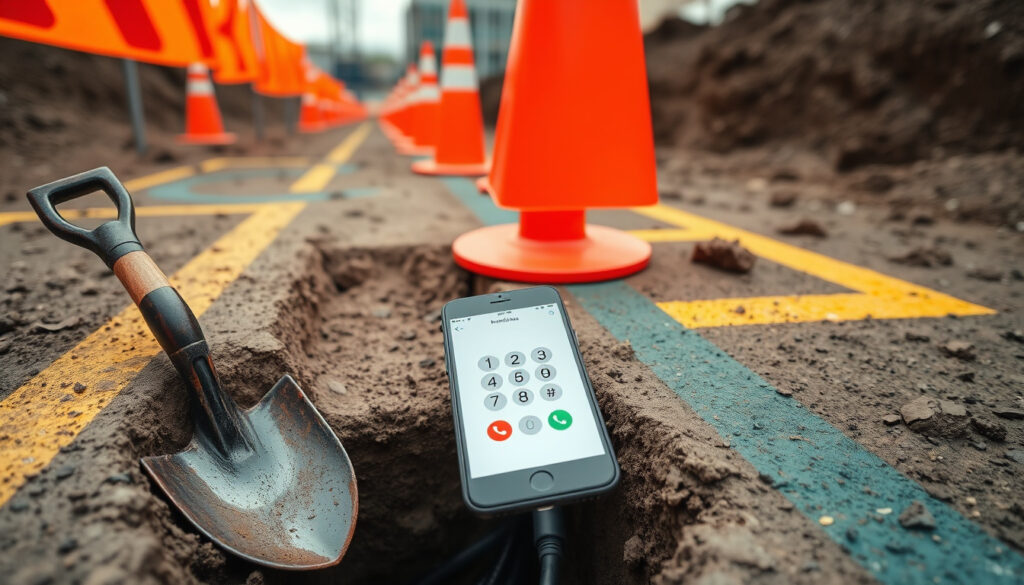
Dial Before You Dig: Free Utility Location Services by Country
You’ve got a shovel in hand and a weekend project ahead—but what if there’s a gas line running right where you plan to dig? That’s exactly the scenario that makes “dial before you dig” services essential — free utility location services available in Australia, Ireland, the UK, and the US, with direct contact numbers, online request options, and practical tips for safe excavation.
Free service in Australia: Yes ·
Gas Networks Ireland contact number: 1800 42 77 47 ·
US national call-before-you-dig number: 811 ·
ESB underground electricity mapping available: Yes ·
Dial Before You Dig renamed in Australia (2023): Before You Dig Australia (BYDA)
Quick snapshot
- Gas Networks Ireland: 1800 42 77 47 or Gas Networks Ireland
- Before You Dig Australia free for all users – BYDA website
- US 811 service free for homeowners – Ohio811 official site
- Linesearchbeforeudig offers free gas/electricity searches in UK – LSUB official site
- Coverage of private pipes (e.g., sprinklers, drains) varies by service
- Accuracy radius of utility markings typically 2-3 feet but not guaranteed
- Response time for online requests depends on utility cooperation
- 2023: Dial Before You Dig Australia rebranded to Before You Dig Australia (BYDA)
- Expect more integrated online request portals across regions
- Growing push for unified cross-country utility locate standards
Ten key facts about dial-before-you-dig services across four countries reveal how each handles underground utility location requests.
| Country | Service Name | Contact Number | Free for Homeowners | Online Request |
|---|---|---|---|---|
| Ireland | Dial Before You Dig (Gas Networks Ireland) | 1800 42 77 47 | Yes | Yes |
| Australia | Before You Dig Australia (BYDA) | Online portal | Yes | Yes |
| US | 811 One-Call | 811 | Yes | Yes, via state portals |
| UK | Individual utilities (LSUB for gas/electricity) | Varies | Varies | Yes, via LSUB |
How do I check before you dig Ireland?
If you’re planning any digging in Ireland, getting utility maps is straightforward. The primary contact for gas pipes is Gas Networks Ireland, which runs its own Dial Before You Dig service. For electricity cables, ESB Networks provides a separate mapping request.
What is the phone number for Gas Networks Ireland?
- Call 1800 42 77 47 – Gas Networks Ireland official site
- Email dig@gasnetworks.ie for inquiries
- Online registration at www.gasnetworks.ie
The pattern: one call or online form connects you directly to the utility owner. According to Gas Networks Ireland guidance, the service is free for basic homeowner requests.
Irish homeowners get free, direct access to gas pipe location info via a single phone number – no middleman, no cost for simple checks.
The implication: Ireland’s model prioritizes direct access with no third-party routing, keeping the process simple for residential users.
Can I check for gas pipes online?
- Yes – Gas Networks Ireland offers an online Dial Before You Dig registration
- Submit your property address and digging details
- Maps are sent electronically or by post
What this means: online requests reduce wait times, but utility maps are typically delivered within a few business days.
Is the service free for homeowners?
- Basic requests are free for residential customers
- Commercial or large-scale projects may incur fees
The trade-off: free for simple home jobs, but if you’re a contractor doing repeat digs, some services charge for multiple or complex requests.
Who do I call before I dig in my area?
In the United States, the national answer is simple: dial 811. This free service connects you to your state’s one-call center, which notifies all member utility companies of your planned excavation.
What is the national call-before-you-dig number in the US?
- Dial 811 – connects to your state’s one-call center – Colorado 811 official site
- Also available online via each state’s 811 portal
- Service is free for homeowners – Ohio811 safe digging page
A single phone call at 811 triggers notifications to gas, electric, water, sewer, and telecom companies – covering the vast majority of underground public utilities in your yard.
How do I find my local one-call center?
- 811 automatically routes you to the correct center based on your phone number and digging address
- For direct contact, most states have a dedicated 811 website (e.g., colorado811.org, georgia811.com)
The implication: you don’t need to research which center to call – 811 handles the routing.
Do I need to call for every digging project?
- Yes – even small projects like planting a tree, installing a mailbox, or building a fence require a locate request – Texas811 guidance
- Non-mechanized digging (e.g., hand shoveling) may be exempt in some states, but all recommend calling – Georgia 811 policy
The catch: even if your project seems minor, buried utilities can be as shallow as 6 inches – one wrong shovel thrust can cause a gas leak or power outage.
Is dial before you dig free in Australia?
Yes, absolutely. The service renamed in 2023 from Dial Before You Dig to Before You Dig Australia (BYDA), and it remains free for all users – homeowners, contractors, and businesses alike.
What is Before You Dig Australia (BYDA)?
- A national free utility location service covering gas, electricity, water, and telecoms – BYDA official site
- Formerly known as Dial Before You Dig (rebranded early 2023)
- Operates as a centralized online request portal
How do I request free plans?
- Go to www.byda.com.au and fill in your project details
- No fee for any request – even commercial ones
- Participating utility owners provide plans at no charge
What this means: Australia leads in making utility locating universally free, removing cost barriers that might tempt people to skip the safety check.
While the request is free, the accuracy of plans depends on each utility’s records – not all private pipes (e.g., irrigation) are mapped.
The pattern: Australia treats utility locate as a public safety service funded by member utilities, not by excavators.
Are there any fees for commercial requests?
- No – BYDA is free for all commercial users as well
- Contractors, builders, and landscapers can submit unlimited requests
How do I find out what pipes are under my garden in the UK?
In the UK there is no single national number, but several free and paid services can help. For gas and electricity, Linesearchbeforeudig (LSUB) offers free online searches. Water companies and telecoms have their own mapping services.
Which utility companies should I contact?
- Gas: National Grid (or your local gas distribution company) – Linesearchbeforeudig free service
- Electricity: Distribution network operator (DNO) for your region
- Water: Your local water company (e.g., Thames Water, Severn Trent)
Is there a central service like Linesearchbeforeudig?
- LSUB provides a free centralised online search for gas and high-pressure electricity pipelines
- Water and telecoms are not covered by LSUB – you must contact them separately
The catch: the UK lacks a single all-in-one service, so you may need to make multiple requests for a complete picture of underground infrastructure.
Do I need to pay for pipe location in the UK?
- LSUB searches are free
- Some water companies provide free basic maps for homeowners; detailed plans may incur a small fee
The implication: UK homeowners can get free gas/electricity maps, but water and telecom maps may cost money or require separate requests.
How to find out what pipes are in your garden?
Whether you’re in the UK, US, Ireland, or Australia, the process follows a similar pattern: provide your address, describe the digging area, and wait for utility owners to mark the lines.
- Identify the relevant utility location service for your country and region.
- Gather your property address, specific digging location, project type, and planned start date.
- Contact the service by phone or online portal at least 2–5 business days before digging.
- Wait for utility owners to mark underground lines with paint or flags at no charge.
- Check the markings and dig carefully within the designated area, respecting the utility buffer zone.
What information do I need to provide?
- Property address and specific digging location
- Type of project (e.g., fence, tree planting, excavation)
- Planned start date and depth of digging
How deep do utility pipes typically run?
- Gas lines: usually 18-24 inches deep
- Water lines: typically 3-6 feet
- Electric cables: often 18-24 inches, but can be shallower
- Telecom/fiber: sometimes as shallow as 6 inches
Even standard depths vary widely by region and soil. The safest approach is to always request a locate, regardless of your assumed depth.
The implication: relying on assumed depth is risky — official locates are the only reliable method.
Can I use a pipe locator device myself?
- DIY pipe locators exist (e.g., electromagnetic locators) but are not 100% reliable
- Utility companies provide official marking (paint or flags) at no charge
- Marks are usually placed within 2-3 feet of the actual line – Colorado 811 accuracy guidance
What this means: professional locates are free and more reliable than consumer devices. Leave the detection to the experts.
How do I contact ESB for Dial Before You Dig?
ESB Networks runs the Dial Before You Dig service for all electricity cables in Ireland. The service is free for basic residential requests and can be accessed online or by phone.
What is the ESB Dial Before You Dig number?
- Contact ESB Networks via phone or online at www.esbnetworks.ie/safety/digging-and-excavation-work – ESB Networks official safety page
- Dedicated number available on their website
Can I request electricity maps online?
- Yes – ESB Networks provides an online request form for underground electricity maps
- Submit your address and project details
- Maps are sent within a few business days
Is the service free?
- Free for basic, non-commercial requests
- Commercial projects may require a fee
The pattern: Ireland keeps it simple – one call or online request for gas (Gas Networks Ireland) and one for electricity (ESB Networks), both free for homeowners.
Clarity: what’s confirmed, what’s unclear
Confirmed facts
- Calling 1800 42 77 47 reaches Gas Networks Ireland DBYD
- Dial Before You Dig is free in Australia (BYDA)
- ESB Networks provides free electricity mapping
- US 811 service is free for homeowners
What’s unclear
- Whether DBYD services cover all private pipes (e.g., sprinkler lines, private drains)
- Exact accuracy radius of utility markings (typically 2-3 feet but varies)
- Response time for online requests (depends on utility cooperation)
- Whether non-mechanized hand digging is legally required to notify (varies by state)
- Linesearchbeforeudig coverage across all UK regions and utility types
- Colorado 811 requires three business days notice – Colorado 811
- Texas 811 requires two business days notice – Texas811
“It is essential to check for the location of gas pipes by calling 1800 42 77 47, emailing dig@gasnetworks.ie or registering for a Dial Before You Dig Online service.”
Gas Networks Ireland – Safe Digging Guidance
“Access ESB Dial Before You Dig for safe digging guidance. Request underground electricity maps, plan work safely, and prevent hazards to the community.”
ESB Networks – Safety Page
The risk of striking a buried utility is real – each year thousands of accidents cause injuries, service outages, and costly repairs. For any homeowner or contractor in Australia, Ireland, the UK, or the US, the choice is clear: make a free call or online request before you dig, or face the potentially severe consequences of hitting a gas line or power cable.
Related reading: Find My Device: Locate Lost Phone (Android, iPhone, Samsung) · Deep Tissue Massage: Benefits, Differences, & Risks
For those working in Ireland, the Irelands dial before you dig guide provides local contact numbers and safety tips tailored to the region.
Frequently asked questions
What happens if I damage a utility line while digging?
You could face fines, repair costs, and even legal liability. In many jurisdictions, failing to call before digging is a violation. Contact the utility immediately if you hit a line.
Do I need to call for small garden projects like planting a tree?
Yes – even shallow digging can strike utilities. Most one-call services recommend calling for any project that disturbs soil more than a few inches.
How long does it take to get a response after requesting utility maps?
Typical wait times range from 2 to 5 business days, depending on the service and utility cooperation. For US 811, the standard is 48-72 hours.
Can I dig without calling if I already know where pipes are?
No – records can be incomplete, and utility maps may not show recent installations or private lines. Always request an official locate.
Is there a fine or penalty for not calling before digging?
Yes – many US states impose fines of several thousand dollars for violating the one-call law. Similar penalties exist in Australia and Ireland.
How accurate are the utility maps provided by Dial Before You Dig?
Maps are based on utility records and are generally accurate to within a few feet. Actual field marking by locators provides the most reliable guidance.
Does Dial Before You Dig cover private underground lines like irrigation?
No – private lines (e.g., sprinkler systems, private sewer drains) are typically not mapped. You may need a private locator service for those.
More related posts
 Osher Günsberg: From Andrew G to Finding Happiness Through Faith and Mental Health Advocacy
 RACV Cape Schanck Resort: Golf, Dining & Accommodation Guide
 Yuki Kawamura: Blood Clot Ended His NBA Rookie Season
 Satya Nadella: Biography, Net Worth, Salary & Leadership
 Owala Water Bottle – Insulated Design Keeps Drinks Cold
 Happy Gilmore Age Rating & Parental Guide for 2025
 French Onion Soup Recipe: Secrets, Ingredients, and Chef Tips
 Jagger and Stone: Jackets, Dresses & Clothing Guide