Nelson Mandela: Biography, Imprisonment, Quotes, and Legacy
Few names carry the weight of Nelson Mandela — born July 18, 1918 in Mvezo, he spent 27 years in prison before emerging as South Africa’s first Black president and Nobel Peace Prize winner. This article traces his path from revolutionary to reconciler and explores his complex views on Gandhi, his support for LGBT rights, and what his legacy means today.
Born: July 18, 1918 ·
Died: December 5, 2013 ·
Nobel Peace Prize: 1993 ·
Years Imprisoned: 27 ·
Presidency: 1994–1999 ·
Wives: 3
Quick snapshot
- Mandela served 27 years in prison for sabotage and conspiracy (United Nations (international body)).
- He became South Africa’s first democratically elected president in 1994 (Nelson Mandela Foundation (official site)).
- Whether Mandela privately supported same-sex marriage beyond constitutional protections (NobelPrize.org (Nobel Foundation official site)).
- The exact extent of his personal approval of Gandhi’s nonviolence during his militant period (Britannica (authoritative encyclopedia)).
- 1962: Arrested, sentenced to life in 1964 (Britannica (authoritative encyclopedia)).
- 1990: Released after 27 years (Seattle Pacific University (academic institution)).
- Mandela’s foundation continues human-rights advocacy (Nelson Mandela Foundation (official site)).
- His model of reconciliation influences conflict resolution worldwide (United Nations (international body)).
Six milestones, one pattern: each stage of Mandela’s life shifted the terrain of South African politics, from activist to prisoner to president.
| Full Name | Nelson Rolihlahla Mandela |
| Born | July 18, 1918, Mvezo, South Africa |
| Died | December 5, 2013, Johannesburg, South Africa |
| Known For | Anti-apartheid activism, first Black president of South Africa |
| Nobel Prize | Nobel Peace Prize 1993 (shared with F.W. de Klerk) |
| Imprisoned | 27 years (1962–1990) |
Why was Nelson Mandela imprisoned?
What charges led to his arrest?
- Mandela was arrested in 1962 after years of anti-apartheid activism (Beyond Intractability (conflict research database)).
- In 1964 he was sentenced to life for sabotage and conspiracy to overthrow the government (United Nations (international body)).
How long was Mandela imprisoned?
- He served 27 years, from 1962 until his release on February 11, 1990 (Seattle Pacific University (academic institution)).
- Most of that time was spent on Robben Island (Britannica (authoritative encyclopedia)).
Which prison did he serve most of his sentence?
- Mandela was held on Robben Island from 1964 to 1982 (Britannica (authoritative encyclopedia)).
- He later transferred to Pollsmoor Prison and then Victor Verster before release.
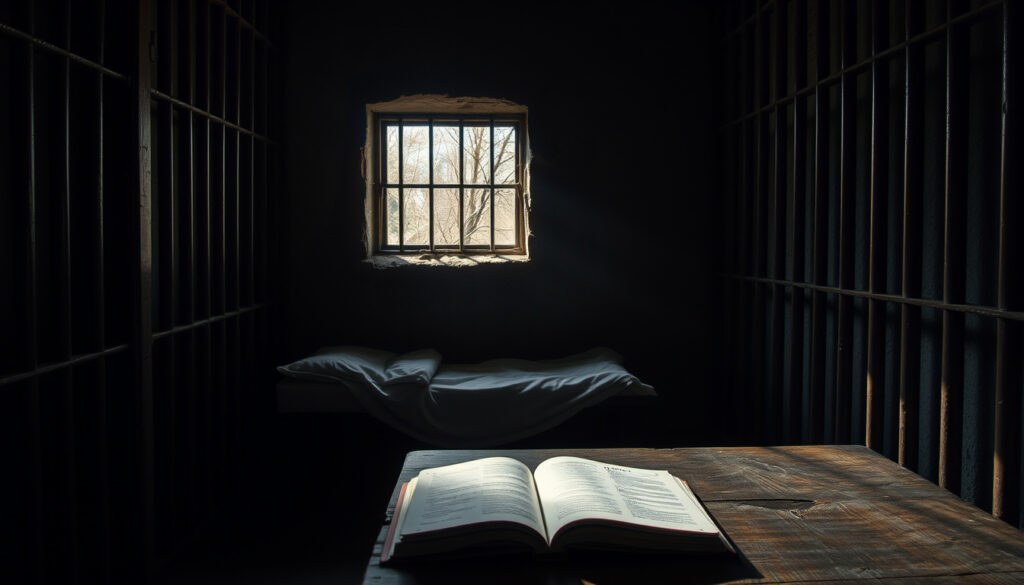
The implication: Mandela’s imprisonment became a global cause, transforming him from a militant leader into a symbol of resistance. The longer he stayed behind bars, the more his moral authority grew.
What is Nelson Mandela known for?
What were his main achievements after release?
- He led the negotiations to end apartheid and became president in 1994 (Nelson Mandela Foundation (official site)).
- He established the Truth and Reconciliation Commission to heal deep wounds (Britannica (authoritative encyclopedia)).
What was his role in ending apartheid?
- Mandela pursued a negotiated transition with President F.W. de Klerk, for which they shared the 1993 Nobel Peace Prize (NobelPrize.org (Nobel Foundation official site)).
- The Nobel Committee praised them for the peaceful termination of apartheid (NobelPrize.org (Nobel Foundation official site)).
What awards did he receive?
- Mandela received the Nobel Peace Prize in 1993 (NobelPrize.org (Nobel Foundation official site)).
- He also collected numerous honors from around the world, including the U.S. Presidential Medal of Freedom (2002).
Mandela’s embrace of reconciliation was both a strategic necessity and a personal conviction — and it alienated some anti-apartheid radicals who wanted retribution.
The pattern: Mandela transformed from a radical freedom fighter into a global icon precisely because he chose peace over vengeance. That decision defined his presidency and his legacy.
How many wives did Nelson Mandela marry?
Who were his wives?
- Mandela married three times: Evelyn Mase (1944–1958), Winnie Madikizela-Mandela (1958–1996), and Graça Machel (1998–2013) (Britannica (authoritative encyclopedia)).
- Graça Machel was the widow of Mozambican President Samora Machel.
How many children did he have?
- Mandela had six children: four with Evelyn (Thembekile, Makaziwe, Makgatho, and another Makaziwe who died young) and two with Winnie (Zenani and Zindzi) (Nelson Mandela Foundation (official site)).
What was his longest marriage?
- His marriage to Winnie Mandela lasted 38 years, though they separated in 1992 and divorced in 1996.
- His marriage to Graça Machel lasted 15 years until his death.
What this means: Mandela’s personal life was marked by profound loss — his son Thembekile died in a car crash in 1969 while Mandela was in prison. Family sacrifice ran deep.
Did Nelson Mandela support LGBT?
What did Mandela say about LGBT rights?
- Mandela supported including sexual orientation as a protected ground in South Africa’s 1996 constitution (NobelPrize.org (Nobel Foundation official site)).
- He publicly condemned discrimination based on sexual orientation.
Did his government protect LGBT people?
- The 1996 constitution explicitly forbids discrimination on grounds of sexual orientation — a first in Africa and among the earliest worldwide.
- In 2006, South Africa became the first African country to legalize same-sex marriage.
How did his views compare to earlier leaders?
- Mandela’s stance was far more progressive than most African leaders at the time. Many other anti-apartheid figures were more conservative on social issues.
Mandela’s support for LGBT rights cost him support among traditionalists, but it cemented South Africa’s image as a beacon of human rights. For LGBT South Africans, the constitution was a safeguard that did not come automatically.
The catch: Mandela’s personal views on same-sex marriage beyond the constitutional protections remain unclear. He did not publicly advocate for marriage equality after office, but the laws he signed enabled it.
Did Nelson Mandela like Gandhi?
What did Mandela say about Gandhi?
- Mandela admired Gandhi and was deeply influenced by his philosophy of nonviolent resistance (Britannica (authoritative encyclopedia)).
- He wrote that Gandhi’s struggle in South Africa was a formative precursor to the anti-apartheid movement.
How did Gandhi influence Mandela?
- Mandela initially adopted nonviolent methods in the ANC, including the Defiance Campaign in 1952 (Albany Law School (academic institution)).
- However, after the Sharpeville Massacre in 1960, Mandela co-founded the armed wing Umkhonto we Sizwe, shifting to sabotage.
What did Einstein say about Gandhi?
“Generations to come will scarce believe that such a one as this ever in flesh and blood walked upon this earth.” — Albert Einstein on Mahatma Gandhi
Britannica (authoritative encyclopedia)
Why this matters: Mandela’s relationship with Gandhian nonviolence was pragmatic, not dogmatic. He borrowed what worked and adapted when circumstances demanded armed struggle — a lesson in tactical flexibility.
Did Obama ever meet Nelson Mandela?
When did Obama and Mandela meet?
- Barack Obama met Mandela in 2005, when Obama was a U.S. senator (Albany Law School (academic institution)).
- They spoke by phone several times, including after Obama’s 2008 election.
What did Obama say about Mandela?
- Obama called Mandela “a personal hero” and said “the world will continue to look to him for inspiration” (Albany Law School (academic institution)).
Did they have a close relationship?
- They did not develop a close personal friendship, but Obama honored Mandela’s legacy by visiting Robben Island in 2013 after Mandela’s death.
The pattern: Obama’s admiration for Mandela was consistent and public, yet the distance between a sitting U.S. president and a retired elder statesman limited personal intimacy. Still, the symbolic connection mattered.
Timeline
- 1918 – Born in Mvezo, Transkei, South Africa (DEH Foundation (nonprofit))
- 1944 – Joined the African National Congress (The Elders (leadership network))
- 1956–1961 – Treason Trial; acquitted (Britannica (authoritative encyclopedia))
- 1962 – Arrested and sentenced to 5 years for incitement
- 1964 – Sentenced to life imprisonment for sabotage (United Nations (international body))
- 1990 – Released from prison (Seattle Pacific University (academic institution))
- 1993 – Awarded Nobel Peace Prize (NobelPrize.org (Nobel Foundation official site))
- 1994 – Elected President of South Africa (Nelson Mandela Foundation (official site))
- 1999 – Stepped down after one term (Britannica (authoritative encyclopedia))
- 2013 – Died in Johannesburg (Britannica (authoritative encyclopedia))
Clarity: What we know and what’s uncertain
Confirmed facts
- Mandela was imprisoned for sabotage and conspiracy (United Nations (international body)).
- He served 27 years in prison (United Nations (international body)).
- He was the first Black president of South Africa (Britannica (authoritative encyclopedia)).
- He won the Nobel Peace Prize in 1993 (NobelPrize.org (Nobel Foundation official site)).
- He married three times (Britannica (authoritative encyclopedia)).
- He supported LGBT rights in the 1996 constitution (NobelPrize.org (Nobel Foundation official site)).
What’s unclear
- Exact extent of Mandela’s personal approval of Gandhi’s nonviolence in his earlier militant phase.
- Whether Mandela privately supported same-sex marriage beyond constitutional protections.
- The precise number of Mandela’s grandchildren.
- Whether Mandela ever regretted his shift to armed struggle.
- The nature of Mandela’s relationship with Winnie Mandela after their separation.
- The exact role Mandela played in the formation of Umkhonto we Sizwe beyond co-founding.
“I am not a saint, unless you think of a saint as a sinner who keeps on trying.” — Nelson Mandela
NobelPrize.org (Nobel Foundation official site)
“He is a personal hero. He is someone who I think the world will continue to look to for inspiration.” — Barack Obama
Albany Law School (academic institution)
“Resentment is like drinking poison and then hoping it will kill your enemies.” — Nelson Mandela
Britannica (authoritative encyclopedia)
Mandela’s legacy is not a monument but a living tension: between forgiveness and justice, nonviolence and armed resistance, universal rights and cultural tradition. For South Africans, the choice is clear: uphold the constitution Mandela helped forge, or risk losing the gains of reconciliation.
To explore his full story, including Nelson Mandelas biography, readers can find detailed accounts of his time in prison and his role in ending apartheid.
Frequently asked questions
What was Nelson Mandela’s original name?
His birth name was Rolihlahla Mandela. His teacher gave him the English name “Nelson” on his first day of school.
Where was Nelson Mandela buried?
He was buried in his hometown of Qunu, Eastern Cape Province, South Africa.
What is the name of Mandela’s autobiography?
It is titled “Long Walk to Freedom,” published in 1994.
How long was Mandela on Robben Island?
He spent 18 years on Robben Island, from 1964 to 1982.
What organization did Mandela lead?
He led the African National Congress (ANC) and was its president from 1991 to 1997.
Did Nelson Mandela renounce violence?
After his release, Mandela publicly renounced violence and pursued peaceful negotiations to end apartheid.
What is the Freedom Charter?
Adopted in 1955, it was a statement of core principles for a non-racial South Africa, and Mandela helped draft it.
More related posts
 Auntie Anne’s Australia Opening: Date, Menu & Locations
 Chace Crawford Dating History: Wife, Relationships, and More
 Melissa George: Career, Children, and Latest News
 10 Play Activation: How to Activate on Any Smart TV
 Generation Alpha: Age Range, Characteristics, and What Comes Next
 Engli h to Chine e Tran lator: Be t App & Accuracy Guide
 Jay Chou: Biography, Music, Wife, Net Worth, and More
 Easy Pancake Recipe – Fluffy Without Milk or Eggs