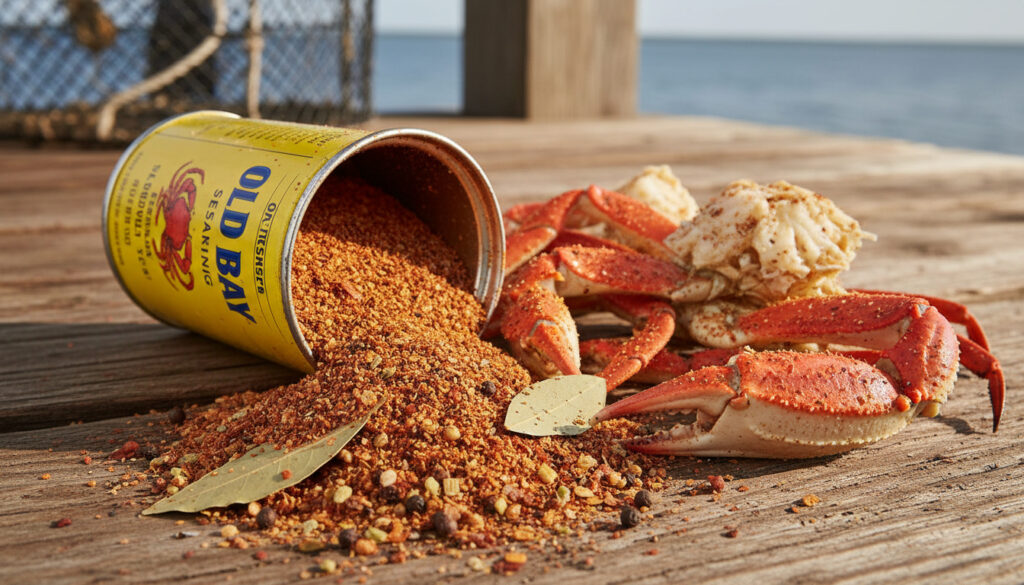
Old Bay Seasoning – Ingredients, History and Uses
Old Bay Seasoning stands as one of America’s most recognizable spice blends, a proprietary mixture of 18 herbs and spices that has defined Mid-Atlantic seafood culture for over eight decades. Created in 1939 by German-Jewish immigrant Gustav Brunn in Baltimore, Maryland, the bright yellow tins have migrated far beyond the Chesapeake Bay, flavoring everything from traditional crab boils to popcorn and Bloody Marys across the globe.
The blend remains unchanged since its creation, now manufactured by McCormick & Company following an acquisition in 1990. Despite its ubiquity in coastal kitchens, the exact recipe remains one of the food industry’s most closely guarded secrets, with only trace ingredients like celery salt, paprika, and mace publicly acknowledged while proportions stay locked in corporate vaults.
Today, Old Bay represents more than a seasoning—it embodies a refugee success story and regional identity that has transcended its maritime origins to become a pantry staple nationwide.
What Is Old Bay Seasoning?
Proprietary seafood spice blend
Baltimore, Maryland, 1939
McCormick & Company (since 1990)
Maryland blue crab boils
- 18-Spice Proprietary Blend: Exact recipe remains secret since 1939 to prevent corporate copying
- Celery Salt Foundation: The dominant flavor profile built on a salt-celery seed base
- Unchanged Formula: McCormick has maintained Brunn’s original recipe without alteration
- Regional to National: Transformed from Chesapeake Bay staple to nationwide pantry essential
- Cross-Category Usage: Originally designed for crustaceans, now used on poultry, snacks, and beverages
- Low-Sodium Alternative: 30% sodium reduction available (95mg vs 145mg per serving)
| Creator | Gustav Brunn (German-Jewish immigrant) |
|---|---|
| Year Created | 1939 |
| Spice Count | 18 herbs and spices |
| Confirmed Ingredients | Celery salt, paprika, mustard, ginger, cinnamon, cloves, mace, bay leaves, cardamom, nutmeg |
| Heat Level | Mild (original); Moderate (Hot variant) |
| Gluten Status | Gluten-free (no wheat ingredients) |
| Serving Size | 1/4 teaspoon (0 calories) |
| Sodium Content | 145mg per serving (original); 95mg (low-sodium) |
| Current Ownership | McCormick & Company |
| Acquisition Price | $11-14 million (1990) |
What Are the Ingredients in Old Bay Seasoning?
The ingredient list for Old Bay Seasoning begins with celery salt as its dominant component, forming the backbone of the flavor profile that consumers recognize. Documentation confirms additional spices including paprika, dry mustard, ginger, cinnamon, cloves, mace, bay leaves, cardamom, and nutmeg appear in trace amounts throughout the blend.
Which Spices Beyond Celery Salt Appear in the Blend?
Secondary ingredients create the complexity that distinguishes Old Bay from simpler seafood seasonings. Black pepper contributes heat without overwhelming the palate, while allspice and nutmeg add warm, aromatic undertones. Culinary historians note that Gustav Brunn specifically selected these 18 components to create a “warm” rather than “hot” profile suitable for delicate crab meat.
Why Is the Exact Formula Considered Secret?
Brunn deliberately omitted key ingredients from product labels during the 1940s and 1950s to protect against corporate espionage. Family accounts reveal that McCormick attempted to copy the blend in identical packaging during the early rivalry years, prompting Brunn to withhold specific components from public disclosure. His son Ralph later confirmed the 18-spice count publicly, specifically mentioning nutmeg as an ingredient others overlooked, yet the precise measurements remain proprietary McCormick intellectual property.
What Are the Nutritional Specifications?
Nutritional data indicates a standard quarter-teaspoon serving contains zero calories and 145 milligrams of sodium. The company produces a low-sodium variant delivering 95 milligrams per serving, representing a 30% reduction achieved through formula adjustment rather than simple salt reduction. No major allergens appear in the ingredient statement, though the facility processes other spices that may introduce cross-contamination risks.
While ingredient lists contain no gluten-containing components, McCormick does not explicitly certify Old Bay as gluten-free. Individuals with celiac disease should verify current manufacturing processes through product packaging.
What Do You Use Old Bay Seasoning For?
Traditional applications center on Chesapeake Bay seafood preparation, particularly blue crab boils where the seasoning permeates shells during steaming. Regional cooking demonstrations emphasize sprinkling the blend directly onto live crabs before steaming, allowing the spices to adhere to meat through the cooking process.
How Did Usage Expand Beyond Seafood?
Mid-Atlantic diners began applying the seasoning to french fries and popcorn during the 1970s, creating “Old Bay fries” as a regional specialty. The blend’s application to poultry gained traction through experimental home cooking, leading to Birria Tacos Recipe – Authentic Beef with Consomé adjacent uses in contemporary recipe development. Eggs, potato salads, and Bloody Mary cocktails represent standard deviations from maritime origins.
What Commercial Product Variants Exist?
McCormick currently distributes specialized packets formulated specifically for crab cakes, salmon, and tuna preparations. The product line extends to tartar sauce and cocktail sauce bases, along with batter mixes for fried seafood. Secondary blends incorporate Old Bay with garlic and herb, lemon, brown sugar, or blackened seasoning profiles for specific protein applications.
What’s a Good Substitute for Old Bay Seasoning?
No commercially available substitute replicates the proprietary balance achieved through Brunn’s original formulation. Competitor attempts during the 1940s failed to capture the nuances, leading to the current monopoly on the specific flavor profile.
Can You Create a DIY Approximation?
Home cooks attempting replication typically begin with a celery salt base comprising approximately 50% of the total mixture. Reverse-engineering efforts suggest adding paprika, black pepper, cayenne, mustard powder, ginger, cinnamon, allspice, mace, cardamom, and ground bay leaf in descending quantities. However, without knowledge of Brunn’s specific proportions and the remaining eight undisclosed spices, approximations remain detectably different to trained palates.
How Does Old Bay Hot Differ From the Original?
Old Bay Hot utilizes the identical 18-spice foundation with increased red pepper content to generate zestier heat. Product specifications indicate the modification involves quantity adjustment rather than additional spice introduction, maintaining flavor consistency while elevating Scoville impact.
Cajun seasoning, while similarly associated with regional American cuisine, employs a completely different spice architecture emphasizing cayenne and garlic. It cannot function as a direct replacement for Old Bay’s celery-forward profile.
When substituting DIY blends for authentic Old Bay in crab cake recipes, reduce additional salt in the dish by 25% to compensate for the celery salt base.
How Did Old Bay Seasoning Evolve Through History?
- : Kristallnacht Arrest – Gustav Brunn arrested in Frankfurt during November pogroms; family secures release via ransom
- : Immigration – Brunn family flees to United States, settling in Baltimore after brief New York stop
- : Company Founded – Baltimore Spice Company established above seafood market on Market Street
- : Product Creation – “Delicious Brand Shrimp and Crab Seasoning” formulated; renamed Old Bay after Chesapeake passenger line
- : McCormick Rivalry – Brunn works three days at McCormick before termination; company subsequently copies product in identical tins
- : Regional Dominance – Becomes synonymous with Maryland blue crab culture; trade association threats from competitors fail to displace brand
- : First Acquisition – Company sold to Smith Corona (via Durkee Foods) following Brunn’s death at age 92
- : McCormick Purchase – Sold to McCormick for $11-14 million; recipe preserved, packaging updated
What Is Known and Unknown About Old Bay’s Recipe?
| Established Facts | Uncertain or Proprietary Information |
|---|---|
| Contains exactly 18 herbs and spices | Complete ingredient list (only 10 confirmed) |
| Celery salt forms the primary base | Precise measurement ratios |
| Recipe unchanged since 1939 | Specific sourcing of raw spices |
| Gluten-free ingredient status | Manufacturing cross-contamination protocols |
| Created by Gustav Brunn | Exact circumstances of Brunn’s 1939 McCormick termination (language barrier vs. antisemitism) |
| Owned by McCormick since 1990 | Current production volume figures |
Why Did Old Bay Become a Regional Icon?
The seasoning’s identity intertwines with Maryland’s maritime economy, where blue crab harvesting defined coastal communities for generations. Brunn’s product arrived precisely as Chesapeake Bay crab houses sought standardized flavoring that could withstand steaming without dissolving, solving a practical culinary problem while creating cultural attachment.
Beyond utility, the brand represents immigrant entrepreneurial success following trauma. The narrative of a Kristallnacht survivor establishing a business that would eventually dominate an American regional cuisine provides symbolic resonance extending beyond gastronomy. Carnival Encounter Deck Plan – Complete Guide to All Decks This heritage, combined with the product’s utility across seafood boils, positioned Old Bay as shorthand for Mid-Atlantic identity.
Contemporary expansion into snack foods and poultry applications reflects changing dietary habits while maintaining the seasoning’s coastal associations. The distinctive yellow packaging functions as visual shorthand for Maryland culture, appearing in gift shops and airport kiosks as edible souvenirs.
Who Documented the Origins of Old Bay Seasoning?
“My father specifically mentioned the 18 spices, including nutmeg, because he wanted people to know it wasn’t just celery salt and paprika. He wanted them to understand it was complex.”
— Ralph Brunn, son of founder Gustav Brunn, regarding recipe secrecy strategies (Source: Mashed)
“They copied our cans exactly. They went to the trade associations and threatened them. But they could never get the recipe right.”
— Brunn family accounts of 1940s competition with McCormick (Source: St. Louis Jewish Light)
What Defines Old Bay Seasoning Today?
Old Bay Seasoning persists as an 18-spice proprietary blend maintaining its 1939 formulation, manufactured by McCormick & Company for applications ranging from traditional crab boils to contemporary snack seasoning. The product balances celery salt prominence against warm spices including nutmeg and cardamom, available in original, low-sodium, and hot variants to accommodate diverse dietary requirements while preserving its status as a regional cultural signifier.
Frequently Asked Questions
Is Old Bay seasoning the same as Cajun seasoning?
No. Cajun seasoning relies on cayenne pepper and garlic powder for heat, while Old Bay emphasizes celery salt and warm spices like cinnamon and nutmeg.
Is Old Bay seasoning vegan?
Yes. The blend contains only herbs and spices with no animal products, though vegans should verify current labels for processing changes.
Can you use Old Bay on beef?
Yes, though unconventional. The celery salt complements ground beef in burgers and meatloaf, particularly for those reducing added salt.
How should Old Bay be stored?
Store in a cool, dry place away from sunlight. The metal tin preserves potency better than plastic alternatives for long-term storage.
Does Old Bay expire?
Spices lose potency after 2-3 years. While not unsafe, aged Old Bay develops muted flavors; replace when aroma weakens.
More related posts
 David Ogden Stiers: M*A*S*H Star, Death & Handshake
 Fitbit Charge 5 Review: Still Good in 2024? Vs Charge 6
 Mazzy Star: The Tragic Story and What Happened to the Band
 Mark Twain: Biography, Tragedies & Controversial Views
 Roman Reigns 2025: Health, Net Worth, and Retirement Plans
 Melissa George: Career, Children, and Latest News
 Jason Taumalolo: Contract, Height, Age & Career Facts
 Generation Alpha: Age Range, Characteristics, and What Comes Next