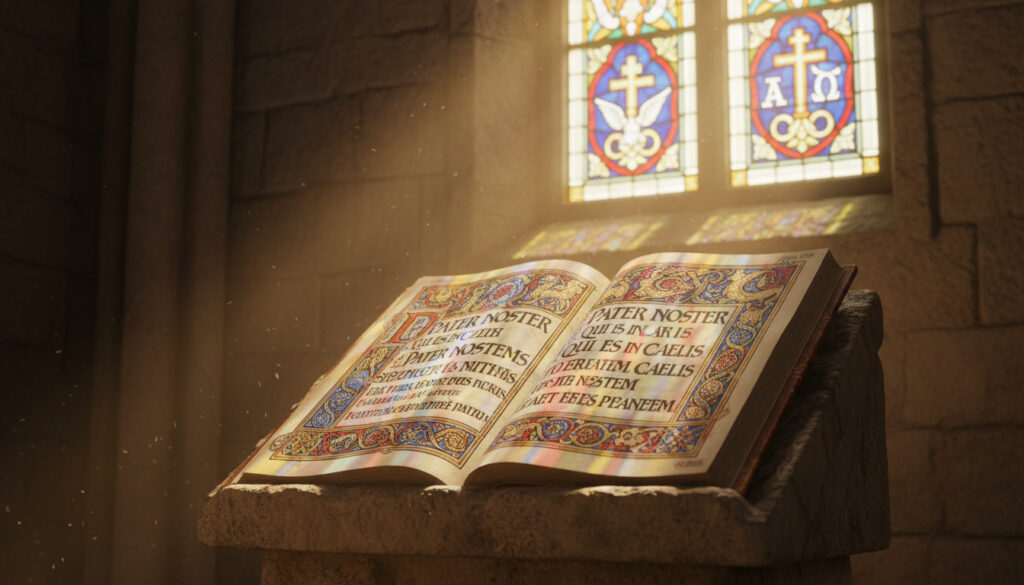
Our Father Prayer – Meaning, Origins and Differences
The Our Father prayer stands as the most widely recognized Christian invocation across denominational lines, spoken in churches, homes, and hospital rooms worldwide. Known traditionally as the Lord’s Prayer or Pater Noster in Latin, this brief yet profound petition encapsulates the core of Jesus’ teaching on prayer and the human relationship with the divine.
Recorded in the Gospel of Matthew and echoed in the Gospel of Luke, the prayer has shaped Christian worship for two millennia, though its precise wording varies between Catholic and Protestant traditions. Its seven petitions address everything from daily bread to ultimate deliverance, offering a framework that balances transcendent hope with immediate human need.
What Is the Our Father Prayer?
Taught by Jesus (Matthew 6:9-13)
Catholic (without doxology), Protestant (with doxology)
God’s kingdom, daily needs, forgiveness
Universal Christian prayer across denominations
The Our Father represents Jesus’ direct response to the disciples’ request to be taught how to pray. Unlike repetitive pagan invocations, this model prayer prioritizes divine glory before human need, establishing a theological order that has defined Christian spirituality.
- Jesus provided this prayer as a model rather than a formula to be repeated mechanically
- The prayer appears in two biblical versions, with Matthew’s account serving as the longer liturgical form
- Catholic and Protestant traditions differ primarily regarding the inclusion of the doxology
- The Aramaic original reflects Jesus’ native language, though surviving manuscripts exist only in Greek
- Modern biblical scholarship favors shorter early manuscripts over later expanded texts
- The prayer bridges Jewish liturgical tradition with distinctively Christian theological claims
- Early Church documents like the Didache (c. 100 AD) already reference the prayer with the doxology
| Fact | Details |
|---|---|
| Bible References | Matthew 6:9–13; Luke 11:2–4 |
| Author | Jesus Christ |
| Length | 56 words (English, traditional text) |
| Original Language | Aramaic (spoken); Greek (manuscripts) |
| Latin Form | Pater Noster (from Vulgate, c. 400 AD) |
| Doxology | Traditional addition: “For thine is the kingdom…” |
What Is the Meaning of the Our Father Prayer?
Each line of the Our Father carries layered theological significance, moving from cosmic adoration to intimate supplication. The prayer structures human desire according to divine priority, placing God’s name, kingdom, and will before petitions for bread or forgiveness.
What Does Each Line of the Our Father Mean?
“Our Father, who art in heaven” addresses God intimately as parent while acknowledging transcendent authority. This opening establishes both familial relationship and cosmic hierarchy, according to Encyclopaedia Britannica.
“Hallowed be thy name” requests that God’s name be revered as holy, prioritizing divine glory over human needs. This petition reflects the biblical concern for God’s reputation and sanctification in the world.
“Thy kingdom come” petitions for God’s reign to be established fully on earth, expressing eschatological hope for the fulfillment of divine sovereignty.
“Thy will be done, on earth as it is in heaven” seeks alignment of human actions with God’s perfect will, implying that heaven serves as the model for earthly obedience.
The petition for daily bread requests both physical nourishment and spiritual sustenance. In Catholic theology, this line carries Eucharistic resonance, while Protestant interpretation emphasizes providential care for temporal needs.
“Forgive us our trespasses, as we forgive those who trespass against us” pleads for mercy conditional upon extending forgiveness to others. Translation variations reflect Greek opheilēmata (debts) versus English “trespasses,” though meanings converge on seeking pardon while granting it, as noted by textual scholars.
“Lead us not into temptation, but deliver us from evil” requests protection from trials and the evil one. Theological interpretation clarifies that God permits but does not cause temptation; the petition acknowledges human vulnerability and seeks divine preservation.
Catholic vs Protestant Versions of the Our Father
While Catholics and Protestants use nearly identical core texts from Matthew, distinct manuscript traditions have created recognizable differences in liturgical recitation. These variations stem from the Reformation’s rejection of the Latin Vulgate and adoption of alternative Greek sources.
Translation Variants and Terminology
The most visible difference appears in the sixth petition: Catholic tradition typically uses “trespasses” and “those who trespass against us,” reflecting the Tyndale and King James lineage. Some Protestant denominations, particularly those following more literal translation principles, use “debts” and “debtors” to mirror the Greek opheilēmata more closely.
The Doxology Question
The primary distinction involves the doxology: “For thine is the kingdom, and the power, and the glory, forever. Amen.” Most Protestant communities recite this conclusion, while Catholics omit it during the Mass and standard daily prayer, as detailed by Catholic theological sources. For those interested in learning more about the Our Father prayer, you can find details about Church near me Ireland mass times.
Catholic tradition follows the earliest Alexandrian manuscripts (Vaticanus, Sinaiticus), which lack the doxology. Early Protestant Bibles utilized the Textus Receptus, which incorporated marginal glosses into the main text. Modern ecumenical scholarship generally favors the shorter biblical form across denominations.
| Aspect | Catholic Version | Protestant Version |
|---|---|---|
| Core Text | Ends “deliver us from evil” (Vulgate/Latin basis) | Same core; some use “debts” (King James influence) |
| Doxology | Omitted in Mass/daily prayer; separate embolism follows | Included in standard recitation |
| Manuscript Basis | Older Greek manuscripts (shorter text) | Byzantine texts with glosses (longer text) |
| Liturgical Use | Central to Mass, Liturgy of the Hours | Used in services, Bible studies, personal devotion |
Where Does the Our Father Prayer Come From?
The Our Father emerges directly from the ministry of Jesus of Nazareth, recorded in the first century Gospels. Its placement within the Sermon on the Mount (Matthew) and the travel narrative (Luke) indicates its central role in early Christian formation.
Who Wrote the Our Father Prayer?
Jesus Christ authored the prayer as recorded in Gospel accounts. Matthew presents it as instructional—”This is how you are to pray”—while Luke records it as responsive teaching to the disciples’ specific request. The prayer likely circulated orally in Aramaic before achieving written Greek form in the canonical Gospels.
Biblical Locations
Matthew 6:9-13 provides the liturgical form embedded within the Sermon on the Mount, addressing personal piety and authentic religious practice. Luke 11:2-4 offers a shorter version, ending at “lead us not into temptation” without “deliver us from evil,” framed within Jesus’ journey toward Jerusalem.
While the Greek text is well established, the exact Aramaic wording spoken by Jesus remains uncertain. Additionally, the original inclusion of the doxology cannot be confirmed, as the earliest surviving manuscripts from the 2nd-4th centuries omit this conclusion.
What Are the Origins of the Lord’s Prayer?
- : Jesus teaches the prayer to his disciples in Galilee and Judea.
- : The prayer is recorded in the Gospels of Matthew and Luke, circulating among early Christian communities.
- : Early Church Fathers including Tertullian and Origen reference and comment on the prayer’s structure.
- : Saint Jerome’s Latin Vulgate translation produces the Pater Noster, shaping Catholic liturgical use for over a millennium.
- : Protestant Reformers translate the prayer directly from Greek and Hebrew sources, adopting longer manuscript forms that include the doxology.
- : Ecumenical agreements favor the shorter biblical text, though denominational variations persist in liturgical practice.
Is the Doxology Part of the Original Our Father?
| Established Information | Information That Remains Unclear |
|---|---|
| The core text appears in Matthew 6:9-13 and Luke 11:2-4. | The exact Aramaic wording spoken by Jesus. |
| Jesus taught the prayer during his earthly ministry. | The precise date when the doxology entered liturgical use. |
| The earliest Greek manuscripts (2nd-4th century) lack the doxology. | Whether Luke’s version originally included “deliver us from evil.” |
| The doxology reflects ancient Jewish prayer patterns. | The specific circumstances of the prayer’s first liturgical standardization. |
According to Catholic scholarly analysis, the doxology represents an ancient liturgical addition rather than original Gospel text. The phrase “For thine is the kingdom…” appears as a marginal gloss in some 4th-5th century Greek manuscripts before entering the main text of later Byzantine copies.
Why Is It Called the Our Father Prayer?
The title derives from the prayer’s opening words in Latin—Pater Noster—and its direct address to God as “Father.” This nomenclature reflects the prayer’s function as a communal rather than individual petition; the use of “Our” rather than “My” emphasizes collective identity within the Christian community.
The designation “Lord’s Prayer” distinguishes this model from the “Hail Mary” or other devotional prayers, attributing authorship to Jesus Christ. Academic resources for citing biblical texts can be found using an APA referencing generator.
Sources and Historical Authority
“Our Father, who art in heaven, hallowed be thy name. Thy kingdom come, thy will be done, on earth as it is in heaven.”
— Matthew 6:9-10, Standard Biblical Text
“The Lord’s Prayer is truly the summary of the whole gospel. Since the Lord… after handling over the practice of prayer, said elsewhere, ‘Ask and you will receive,’ and since everyone has petitions which are peculiar to his circumstances, the regular and appropriate prayers are said three times a day.”
— Tertullian, On Prayer, c. 200 AD
How Is the Our Father Used Today?
The Our Father remains the central prayer of Christian worship, recited during Catholic Mass following the Eucharistic prayer and within Protestant services as a corporate expression of faith. Its brevity allows for memorization across language barriers, while its theological density sustains lifelong meditation.
Frequently Asked Questions
How do you pray the Our Father?
The prayer can be spoken silently or aloud, standing or kneeling, alone or in community. Traditional Christian practice suggests focusing on each petition sequentially, allowing the words to shape intention and awareness of divine presence.
How is the Our Father used in church services?
Catholics recite the prayer during Mass after the Eucharistic prayer and before the Sign of Peace. Protestants typically incorporate it into worship services, Bible studies, and personal devotions, often using it as a framework for extended prayer.
When to say the Our Father prayer?
Christians traditionally pray the Our Father during morning and evening prayers, before meals, during worship services, and in times of crisis. The Catholic Church prescribes it as part of the Liturgy of the Hours and the Rosary.
What is the doxology in the Our Father?
The doxology consists of the words: “For thine is the kingdom, and the power, and the glory, forever. Amen.” It serves as a liturgical conclusion affirming God’s eternal sovereignty, though it does not appear in the earliest biblical manuscripts.
Why do some versions use “debts” and others “trespasses”?
“Debts” translates the Greek opheilēmata literally, reflecting a financial metaphor for sin. “Trespasses” entered English through William Tyndale’s translation and emphasizes moral wrongs. Both convey the concept of spiritual indebtedness requiring forgiveness.
What is the difference between the Matthew and Luke versions?
Matthew’s version (6:9-13) includes seven petitions and ends with “deliver us from evil.” Luke’s version (11:2-4) is shorter, omits “thy will be done,” and ends with “lead us not into temptation,” lacking the final deliverance petition.
More related posts
 Ray-Ban Sunglasses Buyers Guide: Price & Authenticity
 Low Taper Fade – Refined Style for Men
 Brandy Melville Australia: Stores, Shipping & Sizing Guide
 Portable Gas Stove – Best Picks Safety and Buying Guide
 Tony Todd: Candyman actor’s death at 69 and legacy
 Magic Johnson: Biography, Net Worth, HIV Diagnosis & Career
 Bangalow Palm Guide: Growth, Care, Roots, and Common Questions
 Darcy Cameron: Biography, Trade, and Copeland Trophy