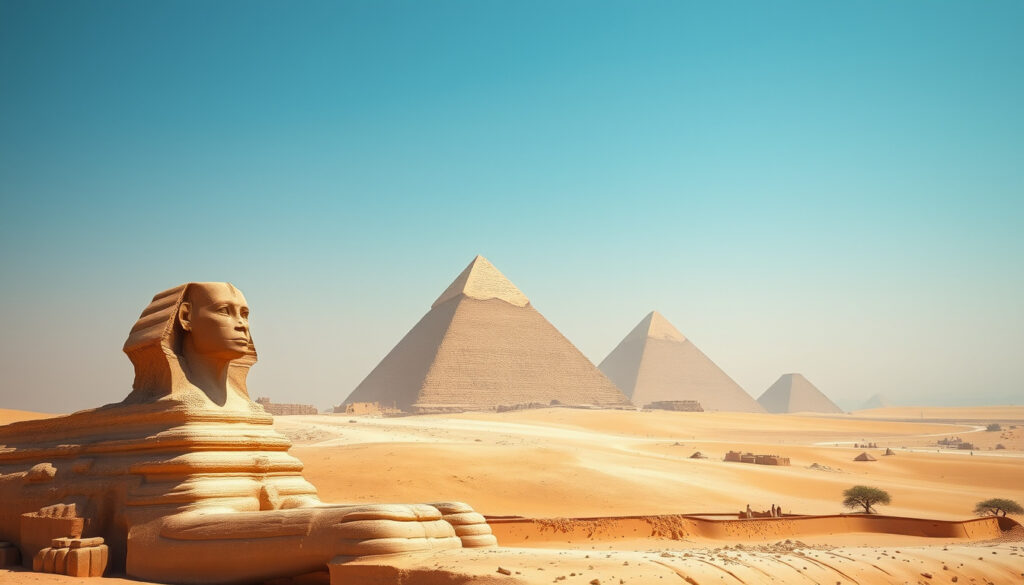
Pyramids of Giza: Facts, History, Location, Secrets
The Pyramids of Giza have sparked awe and curiosity for thousands of years. This fact-based tour covers what archaeologists have confirmed about the pyramids, what remains debated, and what makes them enduring icons of human achievement.
Height (Great Pyramid): 146.6 m (481 ft) originally; 138.8 m (455 ft) today · Construction period: c. 2589–2566 BC (Khufu); c. 2558–2532 BC (Khafre); c. 2532–2503 BC (Menkaure) · Location: Giza Plateau, Egypt (west bank of the Nile) · Number of main pyramids: 3 (Khufu, Khafre, Menkaure) · Base area (Great Pyramid): 13 acres (5.3 hectares) · UNESCO World Heritage site: Yes (1979)
Quick snapshot
- Built as tombs for 4th Dynasty pharaohs (Britannica)
- Great Pyramid originally 146.6 m tall (Discover Egypt’s Monuments)
- Skilled workers, not slaves, built them (Britannica)
- Exact method of moving 2.3 million stone blocks
- Purpose of the 2017 ‘Big Void’ discovery
- Whether all internal chambers are known
- 2589–2566 BC: Great Pyramid built for Khufu (Britannica)
- 1311 AD: No longer world’s tallest structure (Discover Egypt’s Monuments)
- 1979: UNESCO World Heritage inscription (Britannica)
- ScanPyramids continues non-invasive exploration (Britannica)
- New theories on block transport emerge yearly (Britannica)
- Increased tourism and conservation efforts (Britannica)
The three main pyramids, ordered by size, reveal a clear pattern of ambition. Here is a comparison of their key dimensions.
| Pyramid | Pharaoh | Construction period | Original height | Base length | Notable features |
|---|---|---|---|---|---|
| Great Pyramid of Khufu | Khufu | c. 2589–2566 BC | 146.6 m | 230.36 m | Only surviving Wonder of the Ancient World |
| Pyramid of Khafre | Khafre | c. 2558–2532 BC | 143.5 m (now 136.4 m) | 215.25 m | Appears tallest due to higher elevation; retains some casing stones |
| Pyramid of Menkaure | Menkaure | c. 2532–2503 BC | 66 m (now 65.5 m) | 108.5 m | Smallest of the three; built with limestone and granite |
The implication: the three pyramids represent a concentrated building spree spanning less than a century — a feat of centralized planning unmatched for millennia.
Three pyramids, three pharaohs, one plateau: the numbers reveal a clear pattern of ambition. Here are the key facts at a glance.
| Attribute | Value |
|---|---|
| Construction period | c. 2589–2503 BC (4th Dynasty) |
| Builders | Pharaohs Khufu, Khafre, Menkaure |
| Location | Giza Plateau, Egypt (west bank of the Nile) |
| Materials | Limestone (core), granite (chambers), mortar |
| UNESCO status | World Heritage site since 1979 |
| Tallest structure | Great Pyramid: world’s tallest human-made from c. 2560 BC to 1311 AD |
The implication: the pyramids represent a concentrated building spree spanning less than a century — a feat of centralized planning unmatched for millennia.
The Giza pyramids were built in just three consecutive reigns — roughly 90 years total. For context, that’s less time than between the signing of the US Declaration of Independence and today, using only manpower, ramps, and copper tools.
What are 5 facts about the pyramids?
Great Pyramid height and age
- The Great Pyramid originally stood 146.6 meters (481 feet) tall, according to Discover Egypt’s Monuments (Egypt’s official monuments site). Today, after losing its outer casing stones, it measures 138.8 meters.
- It was built around c. 2589–2566 BC for Pharaoh Khufu, making it over 4,500 years old.
- Its base covers 13 acres (5.3 hectares), with sides rising at a precise 51°52′ angle.
Construction materials and labor
- The pyramid contains an estimated 2.3 million stone blocks, each weighing 2.5 to 15 tons on average.
- Local limestone formed the core; higher-quality limestone from Turah was brought by ship for the outer casing, as documented by Discover Egypt’s Monuments.
- The workforce consisted of thousands of skilled laborers housed in purpose-built villages — not slaves, as confirmed by Britannica.
Alignment and astronomical purpose
- The sides of the Great Pyramid align to the cardinal points with remarkable precision — within a small fraction of a degree.
- This alignment suggests the ancient Egyptians had sophisticated astronomical knowledge, though the exact methods remain debated.
The only surviving Wonder of the Ancient World
- The Great Pyramid is the sole surviving structure from the Seven Wonders of the Ancient World, as noted by Discover Egypt’s Monuments.
- It held the title of the world’s tallest human-made structure for approximately 3,800 years — from around 2560 BC until the completion of Lincoln Cathedral in England around 1311 AD.
Three pyramids for three pharaohs
- The Giza complex includes three main pyramids: the Great Pyramid of Khufu, the Pyramid of Khafre, and the Pyramid of Menkaure (from oldest to youngest).
- The Pyramid of Khafre often appears the tallest due to its higher elevation, though it is slightly shorter than the Great Pyramid.
These five facts establish that the pyramids were not random monuments but precision-engineered tombs built by organized labor, with a durability record that has outlasted every other ancient wonder.
Who built the pyramids of Giza and why?
Pharaohs Khufu, Khafre, and Menkaure
- The northernmost and oldest pyramid was built for Khufu (4th Dynasty, c. 2589–2566 BC).
- The middle pyramid belongs to Khafre (c. 2558–2532 BC), Khufu’s son or successor.
- The southernmost pyramid was built for Menkaure (c. 2532–2503 BC), Khafre’s successor.
Purpose: royal tombs for the afterlife
- All three pyramids functioned as tombs to house the pharaoh’s body and possessions for the afterlife, per Britannica.
- The complex also included mortuary temples, causeways, and smaller pyramids for queens.
Who actually built them: skilled workers, not slaves
- The notion of slave labor is a myth. Egyptologists like Zahi Hawass have highlighted tombs of workers discovered near the pyramids, indicating they were paid laborers.
- Evidence from worker villages shows they received rations of bread, beer, and meat — suggesting a respected, organized workforce.
Zahi Hawass, the Egyptian archaeologist, has highlighted the tombs of workers discovered near the pyramids, indicating they were paid laborers.
Zahi Hawass (as reported by multiple news outlets)
While we know who commissioned the pyramids and why, the precise hierarchy of supervisors, engineers, and laborers remains fuzzy. The Greek historian Herodotus reported that 100,000 men worked for 20 years, but modern estimates put the number closer to 20,000 to 30,000 rotating laborers.
Herodotus, the Greek historian, wrote that 100,000 men worked for 20 years to build the Great Pyramid, though modern estimates are lower.
Herodotus, Histories (5th century BC)
The pattern: the pyramids were acts of royal patronage and religious devotion, not brute-force slavery. Each pharaoh’s pyramid marked his claim to eternity, with a workforce that was probably better fed and housed than any other construction crew in the ancient world.
Where are the Pyramids of Giza located?
Giza Plateau, west bank of the Nile
- The pyramids sit on the Giza Plateau, approximately 15 km southwest of central Cairo, on the west bank of the Nile.
- The west bank was associated with the afterlife in ancient Egyptian belief — the land of the setting sun.
- Coordinates: 29°58′45″N 31°08′03″E.
Part of the Giza necropolis
- The complex includes the three main pyramids, the Great Sphinx, several smaller pyramids for queens, and elite tombs.
- The site is part of the UNESCO World Heritage site “Memphis and its Necropolis”, inscribed in 1979.
Near modern Giza, Cairo, Egypt
- The pyramids are effectively a suburb of Cairo, easily accessible by taxi or bus.
- They belong to Egypt and are managed by the Supreme Council of Antiquities.
What this means: the pyramids’ location was no accident — it combined proximity to Cairo (then Memphis) with funerary symbolism, a high plateau for visibility, and access to the Nile for transporting stone.
Does the Bible mention the pyramids of Giza?
No direct biblical reference to the pyramids
- The Pyramids of Giza are not explicitly named anywhere in the Bible.
- The Hebrew Bible (Old Testament) was compiled centuries after the pyramids were built, and its narrative focus is on the Israelites and neighboring peoples, not Egyptian monuments.
Possible indirect connections (grain storage, Exodus)
- Some theories claim Joseph’s grain storage bins (Genesis 41) were the pyramids, but this is archaeologically unsupported — the pyramids were tombs, not granaries.
- The Exodus story mentions Egypt but not the pyramids specifically.
Common misconceptions and scholarly views
- The pyramids predate the Exodus by roughly 1,000 years, Britannica confirms they were complete by c. 2503 BC.
- No biblical verse describes their construction or lists them as landmarks, despite later Jewish and Christian traditions placing them in Egypt.
The trade-off: if you’re looking for biblical proof of the pyramids, you won’t find it. The silence is not a contradiction — the pyramids simply belong to a different time and civilization than the biblical authors’ focus.
What is the biggest secret of the pyramids?
How the blocks were raised and placed
- The most enduring mystery: no single accepted theory explains how 2.3 million stone blocks were moved, lifted, and precisely placed.
- Theories include straight ramps, zigzag ramps, internal ramps, and water-based lifting — but none have been proven by physical evidence.
The void inside the Great Pyramid (ScanPyramids project)
- In 2017, the ScanPyramids project announced the discovery of a large void above the Grand Gallery, dubbed the “Big Void”. It is at least 30 meters long.
- Its purpose remains unknown — it could be a hidden chamber, a structural gap, or a construction ramp.
Astronomical alignments and mathematical precision
- The pyramid’s base is level to within a few centimeters despite covering 13 acres.
- The ratio of the pyramid’s perimeter to its height approximates 2π, suggesting deliberate mathematical design.
Unsolved mysteries: still debated by Egyptologists
- Whether all internal chambers and passages have been discovered is unclear.
- The precise symbolism of the pyramid shape in ancient Egyptian religion remains debated.
The pattern: the biggest secret may not be a hidden treasure but the simple question of how — how a pre-industrial society achieved tolerances of millimeters on a scale that still impresses modern engineers.
In 2023, new thermal scanning of the Great Pyramid identified temperature anomalies near the Big Void area. Whether this leads to a chamber opening or more mystery, the ScanPyramids project is one to watch for the next breakthrough.
egypttoursgroup.com, en.wikipedia.org, goaheadtours.com, smarthistory.org, pyramid-of-giza.com, si.edu
Frequently asked questions
How many stone blocks are in the Great Pyramid?
An estimated 2.3 million blocks, ranging from 2.5 tons to 15 tons each.
Did slaves build the pyramids of Giza?
No. Evidence from worker tombs and villages shows they were paid, skilled laborers, not slaves.
Can tourists enter the pyramids?
Yes. The Great Pyramid has an interior passage leading to the King’s Chamber, open to visitors (separate ticket required).
What is the Great Sphinx’s relationship to the pyramids?
The Sphinx is part of the Giza complex, thought to represent Pharaoh Khafre, guarding his pyramid.
Are there hieroglyphs inside the pyramids?
Very few. Unlike later pyramids, the Giza pyramids contain almost no internal decoration or hieroglyphs.
How were the pyramid stones transported?
The exact method is unknown. Theories include ramps, sledges, and levers, but no single theory is proven.
What is the Pyramid of Khufu also called?
The Great Pyramid of Giza, or simply the Great Pyramid.
Do the pyramids align with the stars?
The sides align closely with the cardinal points, and some scholars note alignments with Orion’s Belt, though this is debated.
More related posts
 Jarome Luai: Salary, Kids, Panthers Exit, and Parramatta Move
 Reckon One Login: Australia Portal Access Guide
 Ireland Visa Processing Time: How Long Does It Take
 Kitchen Range Hood Guide: Types, Ducted vs Ductless
 Orson Welles: Biography, Films, Exile, and Anti-Racist Legacy
 Leonard Nimoy: Spock, Shatner Friendship & Funeral
 Lisa Blackpink: Biography, Boyfriend, Net Worth 2025
 Ikea Outdoor Furniture – Durable Choices for Patios and Gardens