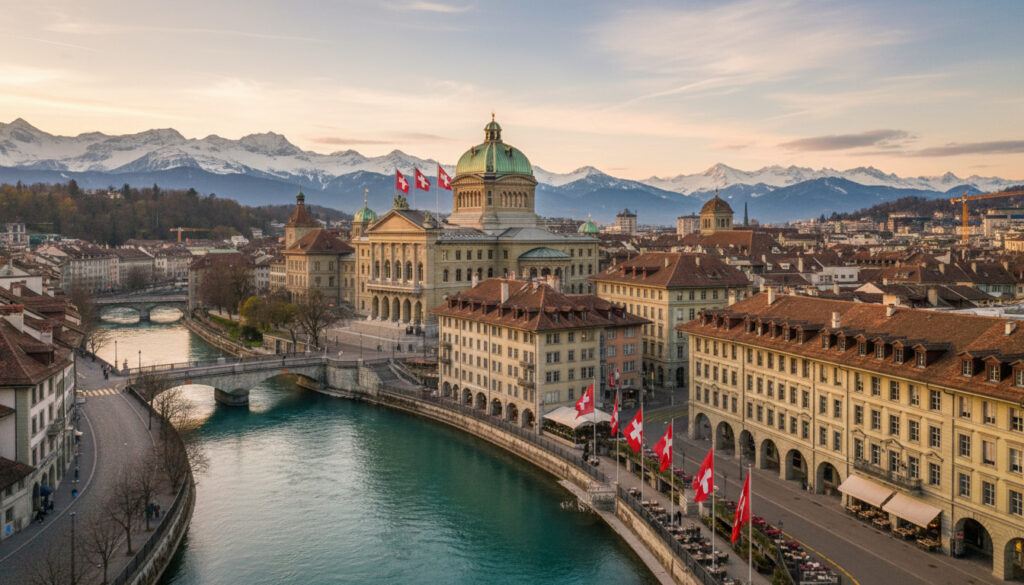
Capital of Switzerland – Why Bern Not Zurich
Many travelers landing in Zurich instinctively assume they have arrived in Switzerland’s capital. The confusion persists for good reason. Zurich commands the country’s largest airport, drives its banking sector, and hosts more international headquarters than any other Swiss city. Yet the administrative center lies elsewhere.
Bern holds the official designation. Since 1848, this compact medieval city has served as the federal city of Switzerland, housing the Federal Assembly, the Federal Council, and all central ministries. The choice reflected a deliberate political calculation to separate economic power from governmental authority.
Understanding why Bern rather than Zurich or Geneva became the capital requires examining the 1848 constitutional convention, the geography of power distribution, and the medieval history that preceded modern federalism.
What Is the Capital of Switzerland?
Bern
Zürich
Bundeshaus (Bern)
1848
The Swiss Federal Constitution establishes Bern as the seat of federal authorities. This status makes Bern the de facto capital, though Swiss officials often use the term “federal city” to describe its administrative function.
Key Insights
- Bern was selected for geographic neutrality, not economic dominance
- Zurich functions as the financial and population center without administrative supremacy
- Common confusion stems from Zurich’s international airport visibility and banking prominence
- Federal architecture deliberately separates political capital from commercial hubs
- Bern’s Old Town holds UNESCO World Heritage status for coherent medieval planning
- The Federal Palace was completed in 1857, nine years after the capital designation
- The 1848 Federal Assembly vote (419 to 313) reflected contentious political balancing
Capital Facts at a Glance
| Official Capital | Bern |
| Population (city proper) | ~135,000 |
| Metropolitan Population | ~430,000 |
| Canton | Bern |
| Primary Language | German (Bernese dialect) |
| Federal Palace | Bundeshaus |
| UNESCO Status | Old Town World Heritage Site (1983) |
| Founded | 1191 |
| Joined Swiss Confederacy | 1353 |
| Became Capital | November 28, 1848 |
Is Zurich the Capital of Switzerland?
Zurich is not the capital. Despite hosting Switzerland’s largest population center and generating the highest GDP of any Swiss city, Zurich was explicitly rejected during the 1848 selection process. The Federal Assembly determined that placing the government in the economic powerhouse would risk conflating commercial interests with federal authority.
Why Zurich Is Often Mistaken for the Capital
With a metropolitan population exceeding 400,000, Zurich towers over Bern’s ~135,000 residents. Its international airport serves as the primary gateway for foreign visitors, while its banking district projects an image of national financial command. These factors create a natural assumption of administrative primacy that contradicts constitutional reality.
The misconception also stems from global patterns where the largest city typically serves as the capital. Switzerland deliberately inverted this norm to preserve cantonal balance. Sources indicate Zurich was avoided specifically to prevent any single commercial center from dominating federal governance according to federal historical records.
Is Geneva the Capital?
Geneva also holds non-capital status. While the city hosts the United Nations European headquarters, the Red Cross, and numerous diplomatic missions, it was not a primary contender during the 1848 federal capital selection. Its French-speaking character and geographic position at the extreme western edge of the confederation distinguished it from Bern’s central, German-speaking heritage.
Why Is Bern the Capital of Switzerland?
Bern became the capital through a combination of medieval confederate history, geographic centrality, and post-revolutionary political compromise. The 1848 decision concluded decades of uncertainty following the collapse of the Helvetic Republic.
When Did Bern Become the Capital?
November 28, 1848, marked the definitive selection. On this date, the Swiss Federal Assembly voted to establish Bern as the seat of government, codifying the decision in the federal constitution. The vote followed the formation of the modern Swiss state after the Sonderbund War.
Bern’s designation passed by a narrow margin of 419 to 313 votes in the Federal Assembly, reflecting the contentious political balancing required to satisfy both Protestant and Catholic cantons.
The 1848 Decision Process
The Federal Assembly evaluated multiple candidates. Zurich represented the economic engine but was rejected to prevent commercial bias in federal governance. Lucerne, though centrally located, carried the stigma of recent involvement in the Catholic Sonderbund War. Bern offered moderate size, defensive fortifications, and a history of confederate loyalty dating to 1353.
The Federal Palace (Bundeshaus) was completed in 1857, nine years after Bern became the capital. Bern initially bore significant construction costs, eventually buying out its federal obligations in 1874 according to the Swiss National Museum.
Bern’s neutrality and modest scale appealed to federalists seeking to prevent any single city from accumulating excessive power. Its position on the Aare River peninsula also provided natural defensive advantages that Zurich’s open lakefront could not match.
During the Helvetic Republic (1798–1803), the capital rotated between Aarau, Lucerne, Bern, and Lausanne. The 1848 Constitution established Bern as the permanent seat to end this instability.
Bern vs. Other Major Swiss Cities
The relationship between Bern, Zurich, and Geneva illustrates Switzerland’s deliberate separation of governmental, economic, and international functions. While Bern concentrates federal administration, Zurich drives commerce and Geneva manages diplomatic relations.
Population disparities highlight this functional division. Bern’s city proper maintains approximately 135,000 residents compared to Zurich’s metropolitan 400,000+. Yet Bern’s role expanded historically through conquests that made it the largest city-state north of the Alps by 1536, annexing Aargau and Vaud during its confederate period as documented in historical guides.
The Our Father Prayer – Meaning, Origins and Differences reflects cultural diversity similar to Switzerland’s linguistic variations, reminding visitors that Bern’s German-speaking character contrasts with Geneva’s French-speaking internationalism.
| City | Population (approx.) | Primary Role | Status |
|---|---|---|---|
| Bern | 135,000 (city); ~430,000 metro | Federal capital since 1848 | Administrative center |
| Zurich | 400,000+ (metro) | Economic/financial hub | Rejected 1848 (power balance) |
| Geneva | ~200,000 (metro) | International diplomacy | Non-contender in 1848 |
How Did Bern Become the Federal City?
Bern’s path to capital status spans eight centuries, from medieval founding to constitutional designation.
-
Berthold V, Duke of Zähringen, founded Bern on an Aare River peninsula, constructing the initial settlement with timber from local oak forests according to Britannica. -
Bern became a free imperial city following the extinction of the Zähringen dynasty. -
Bern joined the Old Swiss Confederacy as its eighth canton, beginning territorial expansion. -
A catastrophic fire destroyed timber structures, leading to reconstruction in gray-green sandstone that defines the modern Old Town. -
Bern hosted the Reformation disputation, establishing Protestant governance. -
The Federal Constitution designated Bern as the federal city on November 28, with the Federal Assembly confirming the selection as recognized by UNESCO documentation. -
Completion of the Federal Palace (Bundeshaus) provided permanent accommodation for federal authorities. -
UNESCO designated Bern’s Old Town as a World Heritage Site for its exceptional medieval urban planning.
What Is Certain About Switzerland’s Capital?
Distinguishing established constitutional fact from common misconception clarifies Bern’s unique status.
Established Information
- Bern is the federal capital per the 1848 Constitution
- The Federal Assembly confirmed this on November 28, 1848
- The Federal Palace physically houses all federal authorities
- Zurich was explicitly rejected to prevent economic dominance
- Geneva was not a primary contender in 1848
Common Misconceptions
- Zurich’s size causes false assumption of capital status
- Geneva’s UN presence implies diplomatic capital functions
- Rotating capitals (1798-1803) sometimes confuse historical timelines
- Exact vote margins (419-313) are often omitted in general references
Understanding Switzerland’s Federal Structure
Switzerland’s political architecture deliberately distributes authority to prevent centralization. This system separates the economic engine (Zurich) from the administrative center (Bern) and the diplomatic hub (Geneva), ensuring no single city dominates national identity.
The federal structure reflects the nation’s multilingual and multicultural composition. By placing the capital in the German-speaking region while maintaining French and Italian as national languages, the confederation balanced cultural representation with administrative efficiency. The Carnival Encounter Deck Plan – Complete Guide to All Decks approach to layered organization mirrors how Swiss federalism arranges governmental functions across distinct geographic and cultural zones.
Bern’s population of roughly 135,000 residents ensures the capital remains approachable, avoiding the congestion and cost pressures that might accompany locating federal functions in a global metropolis. This moderation aligns with Switzerland’s broader political philosophy of decentralization and direct democracy.
Sources and Authority on Bern’s Status
Historical documentation confirms Bern’s constitutional role through official records and academic verification.
“The Swiss Federal Constitution establishes Bern as the seat of the federal authorities, housing the Federal Assembly, Federal Council, and federal administration.”
— Federal Chancellery, Swiss Confederation
The Swiss National Museum provides archival evidence of the 1848 selection process, documenting the narrow Assembly vote and the subsequent construction of the Federal Palace. UNESCO’s 1983 World Heritage designation for Bern’s Old Town further validates the city’s historical significance as a continuous seat of governance since the medieval period as noted in travel documentation.
Summary: Switzerland’s Capital City
Bern stands as Switzerland’s federal capital, designated in 1848 following constitutional consolidation. Unlike Zurich, which functions as the economic and population center, or Geneva, which serves international diplomacy, Bern concentrates federal administration in a compact medieval core recognized by UNESCO. The distinction between economic prominence and political authority remains central to Swiss governance, ensuring that no single city monopolizes national power.
Frequently Asked Questions
What are key facts about Bern Switzerland?
Bern was founded in 1191 by the Duke of Zähringen, joined the Swiss Confederacy in 1353, and became the federal capital in 1848. Its sandstone Old Town is a UNESCO World Heritage Site, and the city houses the Federal Palace (Bundeshaus).
What is the population of Bern Switzerland?
The city proper has approximately 135,000 residents, while the metropolitan area includes roughly 430,000 people, making it significantly smaller than Zurich.
Where is the Swiss federal government located?
The federal government operates from the Federal Palace (Bundeshaus) in Bern, which has served as the administrative center since its completion in 1857.
Is Zurich the capital of Switzerland?
No. Zurich is Switzerland’s largest city and primary economic engine, but Bern has been the official federal capital since November 28, 1848.
Is Geneva the capital of Switzerland?
No. Geneva hosts international organizations including the UN and Red Cross, but it has never served as the federal capital of Switzerland.
More related posts
 Officeworks Five Dock: Hours, Address & Services | Officeworks
 Ronda Rousey: Biography, Health, Career, Net Worth, and Family
 Andrew Bolt: Controversies, Career, and Key Facts
 Brandy Melville Australia: Stores, Shipping & Sizing Guide
 Sophea Pennington: Age, Partner, and Home and Away Role
 300 Series Land Cruiser: Price, Specs, Reliability vs 200 & Prado
 Chace Crawford Dating History: Wife, Relationships, and More
 Boot Camp: Meaning, Types, and Key Facts