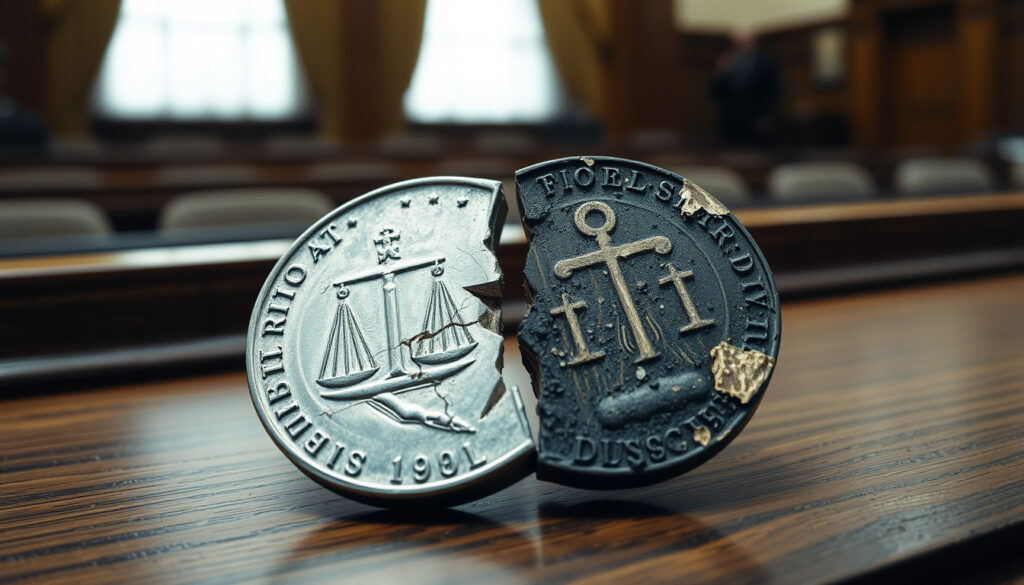
Two-Face Origin: Harvey Dent’s Tragic Fall to Villainy
Few Batman villains spark as much debate as Two-Face, and for good reason: his story isn’t about simple evil, but about how a good man breaks, as created by Bob Kane and Bill Finger in 1942. By the end of this piece, you’ll understand not just how Dent fell, but why his split personality continues to fascinate readers and filmmakers alike.
First appearance: Detective Comics #66 (1942) · Alter ego: Harvey Dent · Former occupation: District Attorney of Gotham City
Quick snapshot
- Two-Face is the alter ego of Harvey Dent, Gotham City’s former district attorney (Wikipedia – community-edited encyclopedia).
- He first appeared in Detective Comics #66 in August 1942 (Wikipedia – community-edited encyclopedia).
- His characteristic coin has one side scarred, the other clean (Batman Wiki – fan resource).
- Whether Two-Face is a full villain or a tragic anti-hero remains debated (Batman Wiki – fan resource).
- The specific psychological diagnosis (e.g., dissociative identity disorder) is implied but never officially confirmed by DC (Wikipedia – community-edited encyclopedia).
- Writer-dependent inconsistencies make his moral alignment fluctuate across story arcs (Wikipedia – community-edited encyclopedia).
- Whether the childhood abuse backstory (introduced in 1990) is considered canonical across all continuities (Wikipedia – community-edited encyclopedia).
- 1942: Two-Face debuts in Detective Comics #66 (Wikipedia – community-edited encyclopedia).
- 1990: Andrew Helfer revises origin in Batman Annual #14, adding childhood abuse (Wikipedia – community-edited encyclopedia).
- 2008: The Dark Knight film introduces Harvey Dent to a global audience (Wikipedia – community-edited encyclopedia).
- 2014: The Big Burn arc ends with Dent’s suicide (Wikipedia – community-edited encyclopedia).
- DC continues to reinterpret Two-Face in comics, TV, and film, with each generation adding new layers to his duality.
A summary of key identifications: Harvey Dent’s transformation hinges on a courtroom accident and a shattered psyche.
| Real Name | Harvey Dent |
| First Appearance | Detective Comics #66 (1942) |
| Created by | Bob Kane and Bill Finger |
| Aliases | Apollo, Janus |
| Affiliation | Injustice League, Suicide Squad (sometimes) |
| Base of Operations | Gotham City |
Why Did Two-Face Become a Villain?
The accident with acid
- A common origin element is that half of Dent’s face is disfigured by acid thrown by mob boss Sal Maroni (Wikipedia – community-edited encyclopedia).
- The attack reportedly takes place in a courtroom during Dent’s career as district attorney (Wikipedia – community-edited encyclopedia).
The breakdown of Harvey Dent’s psyche
- The disfigurement is presented as driving Dent insane, causing coin-flip-based decision making (Wikipedia – community-edited encyclopedia).
- In 1990, Andrew Helfer’s The Eye of the Beholder revised Two-Face’s origin in Batman Annual #14, establishing a history of child abuse by Harvey Dent’s father as a major source of psychological trauma (Wikipedia – community-edited encyclopedia).
- That revision framed Harvey Dent as having dissociative identity disorder, with Two-Face as a second personality state (Wikipedia – community-edited encyclopedia).
The role of the mob boss Sal Maroni
- Sal Maroni is the mob boss who throws acid in Dent’s face in most continuities (Wikipedia – community-edited encyclopedia).
- Maroni’s act is the direct trigger for Dent’s psychological break and subsequent transformation into Two-Face (Wikipedia – community-edited encyclopedia).
The implication: Harvey Dent’s turn to villainy is not a simple moral choice but a consequence of compounded trauma—first from childhood abuse, then from the acid attack. The randomness of the coin mirrors the randomness of the fate that broke him.
Dent’s origin makes him a victim first and a villain second. Readers are asked to sympathize with the man while condemning the monster—a tension that keeps Two-Face one of DC’s most human antagonists.
Is Two-Face a Good or Bad Guy? A Villain or an Anti-Hero?
Two-Face as a villain in DC canon
- He is primarily classified as a supervillain (Wikipedia – community-edited encyclopedia).
- His actions are governed by the flip of a coin, often with lethal outcomes (Batman Wiki – fan resource).
Two-Face as an anti-hero in certain storylines
- Some storylines show him as a tragic figure or anti-hero, especially when his “good” side temporarily prevails (Batman Wiki – fan resource).
- DC’s Batman/Two-Face: Face the Face Deluxe Edition describes Dent as a former foe whom Batman once entrusted with the safety of Gotham (DC – official publisher).
The role of his coin in decision-making
- He becomes obsessed with duality, fate, chance, and sometimes the number two after his transformation (Batman Wiki – fan resource).
- The coin flip replaces moral judgment, making every action a gamble (Wikipedia – community-edited encyclopedia).
What this means: Two-Face defies a clean hero/villain binary. His coin makes him unpredictable—sometimes saving lives, sometimes taking them. The debate over anti-hero vs villain isn’t a fan quibble; it’s baked into the character’s DNA.
Two-Face has been portrayed differently across media. Three major versions show how the same character can shift in alignment:
| Portrayal | Comics (Post-Crisis) | The Dark Knight (2008) | Batman: The Animated Series |
|---|---|---|---|
| Origin | Acid attack by Maroni in court (Wikipedia – community-edited encyclopedia) | Acid thrown by Joker (Wikipedia – community-edited encyclopedia) | Acid explosion caused by former partner (Batman: TAS Wiki – fan resource) |
| Personality | DID with “Big Bad Harv” as second personality (later revisions) (Wikipedia – community-edited encyclopedia) | Trauma-induced split, vengeful but briefly heroic (Wikipedia – community-edited encyclopedia) | Repressed anger leads to “Big Bad Harv” even before accident (Batman: TAS Wiki – fan resource) |
| Relationship with Batman | Friend-turned-foe, occasional ally (Wikipedia – community-edited encyclopedia) | Batman’s hope for Gotham before the fall (Wikipedia – community-edited encyclopedia) | Former ally and trusted friend (Batman Wiki – fan resource) |
The pattern: Each medium reinterprets Dent’s alignment, but the core unpredictability remains constant—he is neither fully hero nor villain.
What Does Two-Face Stand For? Symbolism and the Meaning of the Name
The meaning of the double face
- His appearance represents his internal duality (Wikipedia – community-edited encyclopedia).
- The name refers to his dual nature (good vs evil) (Batman Wiki – fan resource).
The scarred side as evil
- The scarred half of his face is often associated with his criminal persona (Wikipedia – community-edited encyclopedia).
- He uses a scarred two-headed coin to decide his actions, where the scarred side means a negative outcome (Wikipedia – community-edited encyclopedia).
The unblemished side as good
- The clean side of his face is the remnant of Harvey Dent’s former self (Batman Wiki – fan resource).
- His coin has one side scarred, the other clean, mirroring the two sides of his face (Wikipedia – community-edited encyclopedia).
The pattern: Two-Face is a walking metaphor for the randomness of fate. He doesn’t choose between good and evil; he flips a coin and lets chance decide. That’s what makes him so unsettling—he’s a former lawman who has surrendered all agency to luck.
For a character born in 1942, Two-Face’s symbolism of chance-based justice resonates even more in a world where binary choices (scarred vs clean, guilty vs innocent) dominate public discourse. He forces us to ask: how much of our morality is really our own choice?
The implication: Two-Face’s duality isn’t just a gimmick—it’s a commentary on how fragile moral certainty becomes when trauma replaces reason.
What Are Two-Face’s Powers and Personality?
No superpowers but superior intellect
- Two-Face has no superhuman powers (Wikipedia – community-edited encyclopedia).
- He is a genius-level strategist and a master marksman with dual pistols (Wikipedia – community-edited encyclopedia).
Knowledge of criminal law
- As a former district attorney, he knows the legal system inside out (Wikipedia – community-edited encyclopedia).
- This knowledge makes him a particularly dangerous opponent for Batman (Batman Wiki – fan resource).
The compulsion to leave decisions to chance
- His personality is defined by bipolar behavior and obsessive-compulsive traits (Wikipedia – community-edited encyclopedia).
- He is compulsively reliant on his coin to make even trivial decisions (Wikipedia – community-edited encyclopedia).
The trade-off: Two-Face’s lack of superpowers is offset by his brilliant legal mind and marksmanship. But his dependence on the coin is a fatal weakness—one that Batman has exploited repeatedly.
A chronological look at key turning points helps clarify how Two-Face evolved over eight decades.
Timeline: Key moments in Two-Face’s history
| Date / Period | Event |
|---|---|
| 1942 | Two-Face first appears in Detective Comics #66 as a villain with a backstory of being a former attorney (Wikipedia – community-edited encyclopedia). |
| Pre-Crisis | Harvey Dent is established as Gotham’s D.A. and ally to Batman. He is attacked by a mobster in court (Wikipedia – community-edited encyclopedia). |
| Post-Crisis (1986) | The origin is solidified in Batman: Year Two and later The Long Halloween, emphasizing his tragic fall (Wikipedia – community-edited encyclopedia). |
| 2008 | The Dark Knight film features Aaron Eckhart as Harvey Dent, bringing the tragic origin to a wide audience (Wikipedia – community-edited encyclopedia). |
What we know for sure – and what’s still debated
Confirmed facts
- Harvey Dent is the alter ego of Two-Face (Wikipedia – community-edited encyclopedia).
- His face was scarred by acid thrown by Sal Maroni (Wikipedia – community-edited encyclopedia).
- He uses a scarred two-headed coin to decide his actions (Wikipedia – community-edited encyclopedia).
- He is a major adversary of Batman (Wikipedia – community-edited encyclopedia).
What’s still debated
- Whether Two-Face is classified as an anti-hero or a tragic villain remains debated among fans (Batman Wiki – fan resource).
- The extent of his “good” side controlling his actions is often inconsistent across writers (Wikipedia – community-edited encyclopedia).
- The specific psychological diagnosis (e.g., DID, OCD) is implied but not explicitly confirmed by DC (Wikipedia – community-edited encyclopedia).
- The childhood abuse backstory (added in 1990) is not consistently referenced in every adaptation (Wikipedia – community-edited encyclopedia).
Voices on Two-Face
“Harvey Dent was the best of us. He stood for everything that was right. The Joker took that away. But I believed in him.”
— Batman, Batman: The Long Halloween
“I let the coin decide. It’s never wrong. Scarred side means you die. Clean side means you live. Simple.”
— Two-Face, from various comic appearances
“Two-Face is the alter ego of Harvey Dent, Gotham City’s former district attorney, who becomes a criminal mastermind obsessed with duality and the number two.”
— Wikipedia summary
Two-Face remains one of DC’s most psychologically complex characters because his villainy is rooted in real trauma—child abuse, public disfigurement, and the collapse of a career built on justice. For readers who grew up on his story, the lesson isn’t about good vs evil; it’s about how fragile a person’s moral compass can be when fate deals a cruel hand. For fans of Batman, the choice is clear: accept Two-Face as a tragic victim of circumstance, or condemn him as a cold-blooded killer. Either way, the coin will decide.
fanfiction.net, archive.org, reddit.com, youtube.com, keycollectorcomics.com, about-faces.livejournal.com, resetera.com, facebook.com
The tragic origins of Two-Face, including Harvey Dents fall from district attorney, remain one of Batman’s most compelling stories.
Frequently asked questions
Is Two-Face based on a real person?
No, Two-Face is a fictional character created by Bob Kane and Bill Finger for DC Comics.
What is the deal with Two-Face’s coin?
Two-Face uses a two-headed coin that he flips to make every decision. One side is scarred, representing evil; the other clean, representing good. He lets the coin decide his actions.
Does Two-Face have any connections to Poison Ivy?
In some storylines, Two-Face and Poison Ivy have allied, but they are not romantically involved beyond occasional team-ups as Batman villains.
How was Two-Face defeated in the comics?
Batman often defeats Two-Face by exploiting his coin obsession—either by switching the coin or by appealing to the remaining good side of Harvey Dent.
What is the difference between Two-Face in comics vs. the movies?
The core origin (acid attack, coin obsession) stays the same, but movies like The Dark Knight simplify his backstory and drop the childhood abuse trauma introduced in the 1990s comics.
Who created the character Two-Face?
Two-Face was created by writer Bill Finger and artist Bob Kane, first appearing in Detective Comics #66 in 1942.
Related reading
More related posts
 Pyramids of Giza: Facts, History, Location, Secrets
 CommBank Credit Card – Best Options, Fees and Rewards
 Meghan and Harry News: Verified Facts and Key Sources
 Jim Chalmers: Biography, Age, Religion, Wife, Net Worth & More
 Julian Assange: Latest News, Plea Deal, and Where He Is Now
 Jeff Nippard: Fiancée, PhD, Squat Record, and Personal Life
 Raven-Symoné: Bio, Net Worth, Wife, Children, and Career